Washington — In late December, two months before the U.S. war with Iran began, Army Chief of Staff Gen. Randy George warned that his service was critically short on missile defense munitions and that the shortage would last another five years, according to multiple U.S. officials familiar with the matter. Defense Secretary Pete Hegseth ousted George in April, as the Iran war was underway.
George's risk analysis appeared in the Pentagon's Global Force Management Allocation Plan, a defense secretary-approved annual order determining where troops and weapons will be allocated across the globe, according to the U.S. officials who spoke to CBS News.
He warned that the stockpile of Terminal High Altitude Area Defense batteries and Patriot missiles would continue to be strategically low until 2030. His assessment was written for the Defense Department's plan for fiscal year 2027 and before the outbreak of the U.S.-Israel-led war with Iran, now in its seventh month.
U.S. officials who spoke to CBS News under condition of anonymity because they were not authorized to speak publicly said his assessment stemmed from the transfer of Patriots to Ukraine after Russia's invasion in 2022, the expenditure of munitions to defend Israel, and the reduced capacity of the defense industrial base.
CBS News is withholding the exact percentage figures conveyed by U.S. officials because of security concerns, and George declined to comment. U.S. officials say that while the U.S. possesses a significant stockpile of some offensive munitions, like the Joint Direct Attack Munition and Small Diameter Bombs, missile defense munitions used in Terminal High Altitude Area Defense, or THAAD, batteries, and Patriot missile systems are at low strategic-risk levels.
The THAAD system is one of the U.S. military's most advanced missile defense systems, designed to intercept and destroy incoming ballistic missiles during the final phase of their flight, either inside or just outside Earth's atmosphere. The Army has eight THAAD batteries. Each battery consists of 90 soldiers who operate six truck-mounted launchers, with each truck possessing eight launchers. A full battery controls 48 interceptors, according to a 2025 report from the nonpartisan Congressional Research Service.
The Patriot air-defense system is designed to protect military installations, troops and other critical infrastructure from incoming ballistic and cruise missiles, as well as hostile aircraft. It can engage a broader range of aerial threats at lower altitudes than a THAAD battery, but when used together, they provide even more effective overlapping layers of defense against missile attacks.
The Patriot munition at a critical low is the Patriot Advanced Capability-3, or PAC-3, a high-velocity surface-to-air interceptor designed to destroy incoming tactical ballistic missiles and cruise missiles by ramming into them. PAC-3s can also bring down enemy aircraft, according to U.S. officials who spoke to CBS News.
"Those are the two Army munitions that would be most heavily used in a conflict with China," said Mark Cancian, a retired Marine colonel and CSIS Defense and Security senior adviser. "You're not gonna use that many Javelins, for example, because the amount of ground combat is going to be relatively limited, even artillery will be limited, but air defense — missile defense — that will be huge."
An April estimate from the Center for Strategic and International Studies showed that it currently takes defense contractors four years and five months to complete delivery of new THAAD interceptor contracts. Patriot PAC-3 interceptor orders have an average delivery time of three and a half years.
CSIS' estimate said that before the Iran war, the U.S. entered 2026 with roughly 2,300 or so Patriot interceptors and expended between 1,050 and 1,430 during the conflict, potentially consuming as much as 61% of its prewar inventory. Fewer than 500 replenishment munitions were expected to be delivered in fiscal year 2026.
The stockpile for THAAD systems prior to the Iran war sat at around 355 interceptors, with the Iran war using between 190 to 290, or about 82% of its prewar inventory, according to CSIS. There were no expected deliveries for replenishment in fiscal year 2026. In the current fiscal year — 2027 — the U.S. has requested more than 800 THAADs.
Two of the nation's largest defense contractors — Lockheed Martin and RTX, through its Raytheon business — are involved in manufacturing these systems and their key components. They've recently signed agreements aimed at accelerating production.
In January, Lockheed Martin announced a plan to quadruple the production capacity of THAADs from 96 to 400 interceptors per year.
While the war with Iran has caused missile defense munitions to be depleted at a much higher rate, decades of Pentagon spending decisions, a shrinking defense industrial base and successive military operations that consume weapons faster than manufacturers can replace them have contributed to the current shortages.
One U.S. official told CBS News that even if the United States could avoid expending additional THAAD or Patriot munitions in Iran or in other conflicts, it would take until the midterm elections of the next presidential administration — 2030 — to replenish the stockpile to the already-low December 2025 levels.
Contacted by CBS News, Pentagon chief spokesman Sean Parnell said, "Claims of U.S. munitions shortages are false. When the Fake News media irresponsibly amplifies these lies, the real-world consequences is clear: our enemies are emboldened to provide — or attack — American troops."
He added that the U.S. still has "everything required to strike at the time and place of the President's choosing."
"Across multiple combatant commands," Parnell said, "we have already executed successful operations while maintaining a deep, ready arsenal to defend our people and our interests."
How munitions are used around the world
The U.S. military is divided into 11 unified combatant commands, each responsible for either a region of the world or specialized military mission. For operations against Iran, U.S. Central Command, led by Navy Adm. Brad Cooper, is in charge.
Each combatant command needs a certain number of troops and weapons. The Pentagon uses a framework known as Global Force Management to decide where American troops, their units and some of the military's most sought-after weapons are sent around the world.
The Global Force Management Allocation Plan, or GFMAP, is at the center of the process, laying out which forces will be provided to combatant commanders, for what missions and for how long.
The plan is typically organized around the federal fiscal year. Generally, the Pentagon enters a new fiscal year with an existing plan for many of the forces expected to deploy or remain deployed during the coming 12 to 24 months, rather than deciding from scratch each time a commander asks for troops or weapons.
But the plan is not set in stone. Wars erupt, crises develop, missions end and commanders are faced with unanticipated events to address.
For instance, the commander of U.S. European Command might want more Patriots in Poland at the same time that U.S. Central Command wants those same resources in Kuwait, while U.S. Indo-Pacific Command may also need the systems for contingencies involving China.
There's a constant shuffling of troops and assets from one region to another — in one instance in April 2025, Adm. Samuel Paparo, the commander of U.S. Indo-Pacific Command, told the Senate Armed Services Committee that the Army had transferred a Patriot battalion from his region to U.S. Central Command amid ongoing fighting with the Iranian-back Houthi rebels in Yemen.
What led to the current weapons systems shortage?
After the collapse of the Soviet Union, American military planners abandoned the assumption that the U.S. might need to fight a prolonged war against another superpower, explained Cancian.
"After the Cold War, we planned on fighting short regional conflicts against countries like Iraq or North Korea. And for those countries we didn't need the large inventories that we had needed during the Cold War," Cancian said. "We needed much smaller inventories."
He added: "We shrank the industrial base. There was the famous 'Last Supper' which was literally a dinner that the deputy defense secretary put on for the heads of the defense industry, and he told them there's not enough money to keep you all in business, so you're going to have to consolidate or move out of the business, which they did."
The resulting mergers reduced the number of major aerospace and defense contractors from 51 to five, according to the CSIS analysis.
Also, historically, the Pentagon's procurement decisions have reduced spending on ammunition and missiles to free up money for fighter jets, tanks and warships, even while acknowledging that those weapons are essential to war fighting.
Cancian told CBS News that the consolidation of the defense industrial base shaped an industry that produces efficiently during peacetime but is not designed to surge production.
"We squeezed all the surge out because it was seen as unnecessary. So, that's where we end up when the war in Ukraine begins," said Cancian. "And after six months or so, we realized that we just don't have enough munitions and equipment for a protracted conflict."
Under the Biden administration, there was a renewed interest in building surge capabilities back into the defense industrial base but that would take time. As the war between Russia and Ukraine began in full, the U.S. transferred roughly 600 Patriot interceptor missiles to Ukraine. However, not all of those weapons came from American military stockpiles; some were manufactured through the Ukraine Security Assistance Initiative or provided by European countries.
Additionally, both Biden and Trump administrations used Patriot and THAAD missile interceptors to defend Israel against Iranian strikes. Six months before Gen. George's warning assessment, U.S. forces fired roughly 150 THAAD interceptors and almost 80 Patriot interceptors during the Twelve Day War.
Cancian noted that the five-year timeline to bring Patriot and THAAD stockpiles just to the low pre-Iran war levels is based on the assumption that the production schedule stays on track — and that additional military operations do not further deplete the inventory.
This article originally appeared on CBS News at https://www.cbsnews.com/news/randy-george-missile-defense-shortage-iran-china/ (Thu, 15 Oct 2026 20:39:03 +0000)
President Donald Trump is making a broad assertion of executive privilege to keep secret the conversations he has had about plans to renovate the Kennedy Center, the Justice Department said in a court filing this week.
A White House lawyer says in court documents released on Wednesday that Trump's executive privilege --which is the right of a president to keep confidential the communications he has with advisers -- would also cover his conversations with advisers who don't serve in government.
The move comes as Democratic Rep. Joyce Beatty, an ex officio trustee of the Kennedy Center, seeks to obtain information in her ongoing lawsuit challenging the planned closure and renovation of the performing arts center, and whether Trump has plans to demolish it.
In a sworn declaration, Deputy White House Counsel Josh Hoyt said Trump’s executive privilege claim would cover any conversations the president has had with "his advisors (government and non-government)," including Commerce Secretary Howard Lutnick and Kennedy Center Executive Director Matt Floca, as well as anyone on his or the center's staff who may have advised Trump or his aides about "the President's duties and the effective functioning of the Kennedy Center."
Mariam Zuhaib/AP - PHOTO: The John F. Kennedy Center for the Performing Arts is seen, Oct. 8, 2026, in Washington, D.C.
Beyond the president's role as Kennedy Center board chairman, a position to which he was elected last year by his handpicked trustees, administration lawyers say, "in his capacity as President," Trump has "an official role in the Center’s operations."
The Justice Department argues that since the law gives Trump the power to select who serves on the board, he must be positioned to assess whether current and future board members are "managing the Center ably and in accordance with their duties and statutory obligations."
In a deposition taken earlier this month, an attorney who sat beside Floca repeatedly invoked executive privilege, rejecting questions from Beatty’s lawyer about the director's conversations with Trump, and even suggesting that queries about Floca’s talks with Lutnick could also violate Trump's privilege.
Pushing back on the claims, Beatty’s lawyers have argued in court that "these blanket assertions of executive privilege are both procedurally and substantively improper."
Kent Nishimura/AFP via Getty Images - PHOTO: Workers load in new barricades to be used in continuing to surround the main building of the John F. Kennedy Center for the Performing Arts in Washington, D.C., Sept. 17, 2026.
The Trump-aligned Kennedy Center board voted last month to close it for renovations after a federal judge's ruling blocked Trump's name from appearing on the outside of the building, a lawsuit Beatty initially brought last year.
In May, U.S. District Judge Christopher Cooper issued an order blocking the planned two-year closure of the center for renovations, saying the board had not properly weighed the impact of the closure on the center’s finances and programming when it voted on the plan in March.
The Justice Department later asked the judge to dissolve that order so planned renovations could proceed. Cooper has yet to rule on that motion.
This article originally appeared on ABC News at https://abcnews.com/Politics/trump-claims-executive-privilege-kennedy-center-conversations-secret/story?id=137298571 (Thu, 15 Oct 2026 20:21:34 +0000)
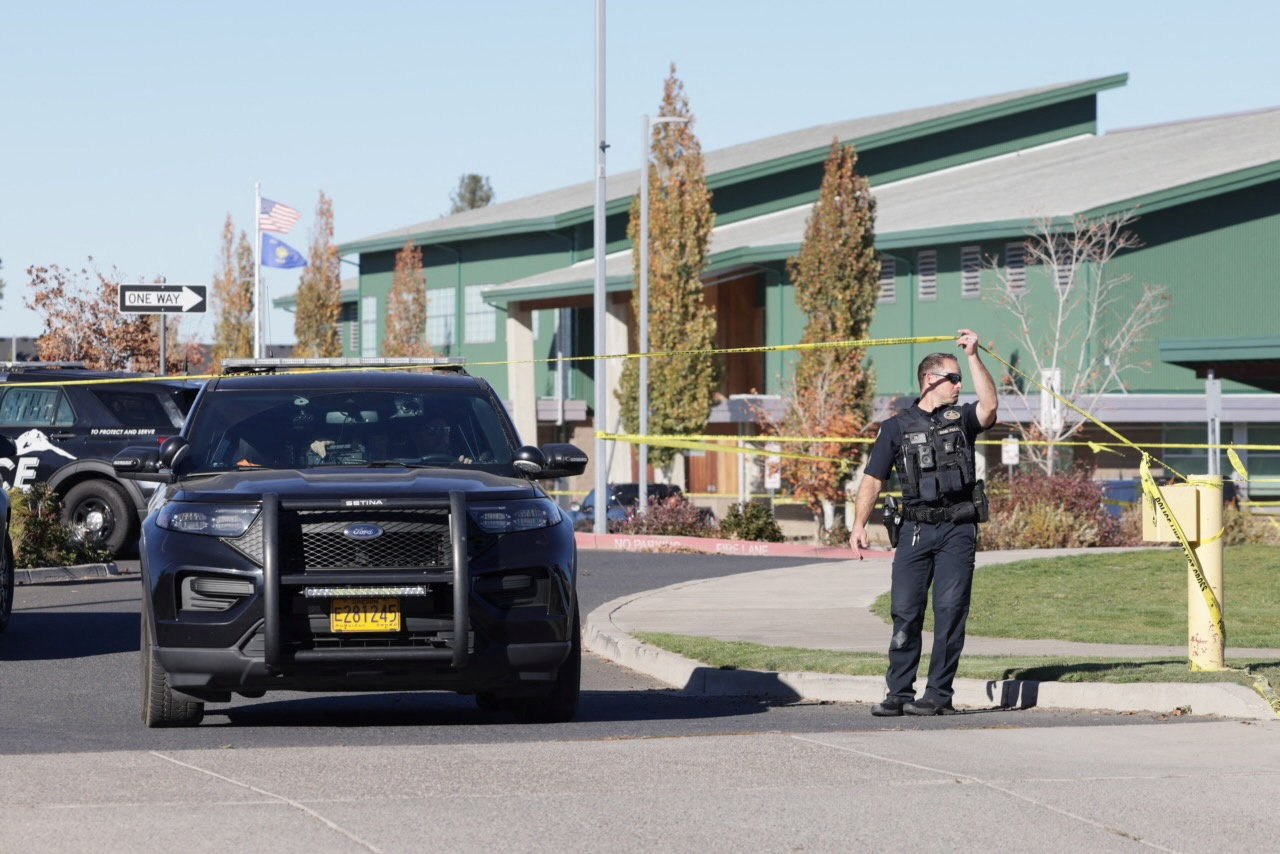
A police officer at the scene of a shooting at Silver Rail Elementary School.
REUTERS / REUTERS
Four people, including three children, were killed after a gunman opened fire at Silver Rail Elementary School in Bend, Ore., on Thursday, according to multipleoutlets. The shooter was also killed, authorities said.
Police first received reports of an active shooter at 12:59 p.m. local time, when an unknown man had fired a gun into a car before entering the school, where he continued shooting, according to the Bend Police Department.
Officers arrived on the scene within three minutes of the initial report. Moments later, the shooter was reported dead after being shot by a community member who followed the suspect into the school, police said.
Bend Police Department Chief Mike Krantz said during a press conference Thursday evening that the children were 5, 8 and 11 years old. One adult, a teacher, was also killed. A 7-year-old child and a 54-year-old teacher were also sent to a hospital with critical injuries.
Krantz said the suspect had been identified as a 16-year-old Bend resident who forced his way into the school by shooting at the locked doors. He did not say what kind of gun the suspect used. He also did not release the names of the victims or the shooter.
People stand near the scene of a shooting at Silver Rail Elementary School in Bend, Ore., on Oct. 15, 2026.
via REUTERS / REUTERS
"Our hearts are broken," said Bend Mayor Melanie Kebler during the press conference. "A school should be a safe place where children can learn and feel secure. What happened today should never happen."
"We are stunned and heartbroken by this senseless tragedy," Bend-La Pine Schools Superintendent Steven Cook wrote in a statement. "We extend our deepest sympathy to the families and to everyone affected by this violence. No words can adequately express the grief our community is experiencing. Our immediate priorities are caring for our students and staff and assisting law enforcement and emergency responders."
FBI Director Kash Patel said the agency was on the scene assisting in the investigation.
Bend-La Pine Schools said it had set up a family reunification site at a nearby church, and that all of its schools would be closed on Friday and any activities and athletic events would be canceled.
"All Oregonians mourn this loss today," said Oregon Gov. Tina Kotek. "This is a horrible day. No parent should have to have this kind of day and no community should have to live through this kind of day. We are going to do a lot of crying. We are going to cry together and we're probably going to cry privately."
This article originally appeared on Yahoo News at https://www.yahoo.com/news/us/article/multiple-people-reportedly-killed-after-shooting-at-oregon-elementary-school-230432197.html (Fri, 16 Oct 2026 01:07:05 +0000)
New White House press secretary Katie Zacharia gave her first press briefing on Tuesday. But she has spent the days since then facing questions about her own legal credentials rather than President Trump's agenda.
Trump announced last Friday that he had chosen Zacharia, a conservative commentator and former Department of Homeland Security spokesperson, to replace Karoline Leavitt, who left the administration in August.
In his post on Truth Social announcing her appointment, Trump described Zacharia as an "attorney" as well as "a devoted fan and member of MAGA!" Zacharia holds both a law degree and a bachelor's degree from Pepperdine University, and her LinkedIn page says she served as "general counsel" at Fix California, a nonprofit founded by former acting Kennedy Center director Ric Grenell to promote conservative policies in the Golden State. In media appearances, she has described herself as a lawyer.
But the Wall Street Journal reported on Wednesday that while Zacharia sat for the California bar exam after graduating from law school, she "didn't pass." A senior administration official confirmed to NBC News that Zacharia did not pass the California bar exam. Reuters also investigated her credentials and "could not find records showing Zacharia was registered as an attorney or member of the bar in any U.S. state or the District of Columbia."
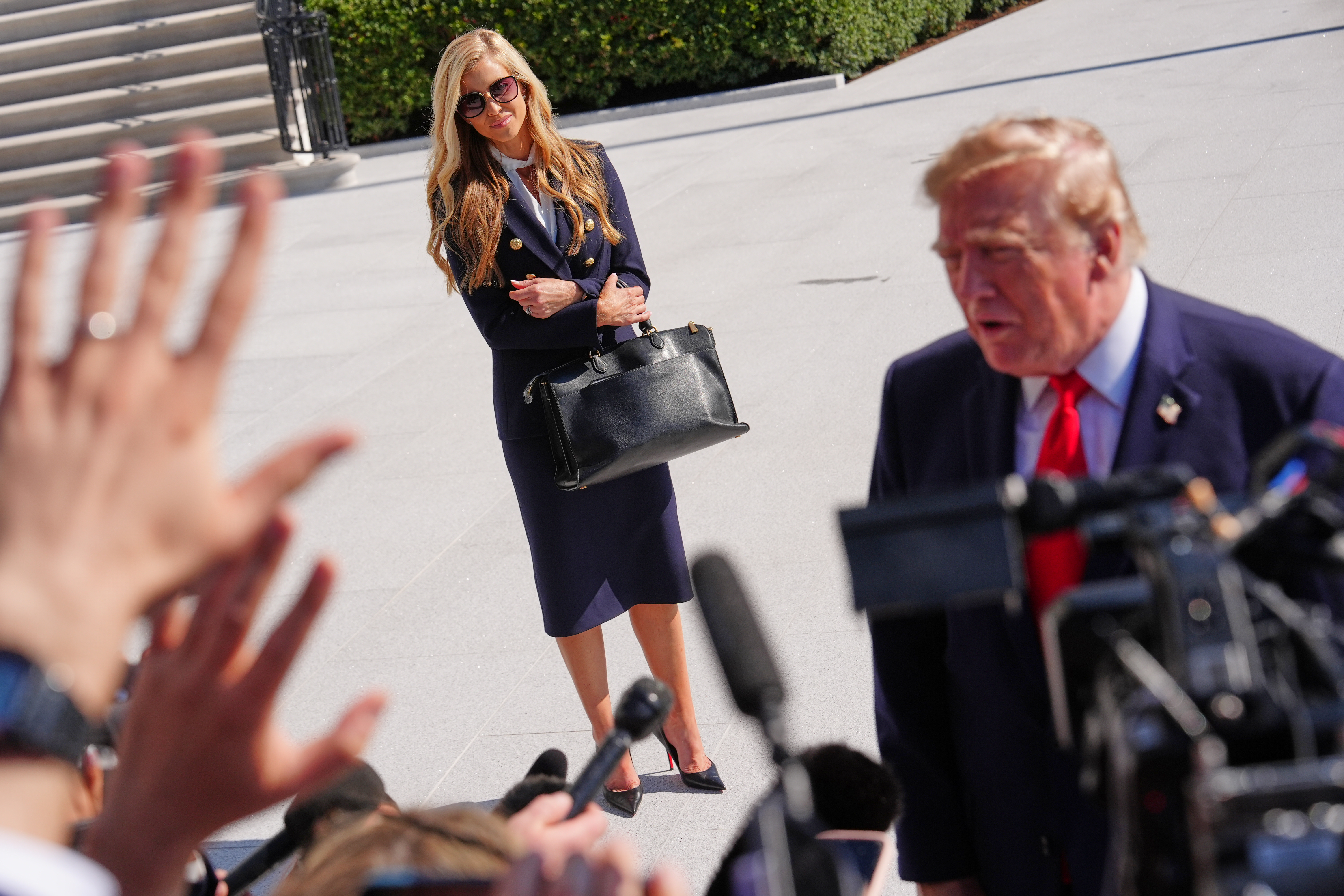
Asked by reporters Tuesday on the South Lawn where she passed the bar, Zacharia twice replied, "When I moved to China."
White House press secretary Katie Zacharia looks on as President Trump speaks to reporters on the South Lawn on Oct. 13.
AP Photo/Julia Demaree Nikhinson
In a phone interview with the New York Times on Wednesday, Zacharia said she misheard the question. "I assumed the question was, 'Where were you after law school?'" she told the paper. "That's all I could hear over the sound of Marine One. And, wanting to respect protocol, the distance behind the president, kept me from moving closer to hear the question."
Zacharia pointed out that it was only her second day on the job.
In a statement to the Washington Post, the White House said that "Katie moved to China with her husband after graduating because of his job at an American private equity firm while she worked on international transaction law." According to USA Today, Zacharia "worked for a Chinese law firm's international-practice team on multimillion-dollar shareholder agreements involving investments through the World Bank." She did not attempt to take the bar exam a second time.
On Thursday, Zacharia confimed that she did not pass the bar, telling the conservative outlet Real America's Voice that she was "incredibly distracted and overwhelmed and excited" at the time by her impending marriage and move to China.
"We just said… 'I'll take the bar and see what happens,'" Zacharia recalled. "The results are somewhat inconsequential because I knew I wouldn't need the bar in China."
Legal experts told the Times that it's debatable whether a law school graduate can describe herself as a "lawyer" before she passes the bar. But she cannot call herself an "attorney" — someone who is licensed to practice law and give legal advice — nor can she serve as a "general counsel" or as an "associate" at a Chinese law firm, they added.
Zacharia told Real America's Voice that she was "very careful about how I executed this and I never came across as somebody who was an attorney-at-law."
"I consulted for a very long time many people in the field — 'Is it OK and acceptable if I label myself 'lawyer' … and provide legal analysis, not legal advice," she explained. "They said, 'Absolutely,' across the board. 'You can call yourself a lawyer.'"
On Wednesday, a nonprofit watchdog group called Campaign for Accountability filed a complaint with the California bar asking it to investigate whether Zacharia had violated state law by "repeatedly holding herself out as a lawyer."
White House spokesperson Steven Cheung responded on social media by dismissing the Campaign for Accountability as a "radical leftist-organization run by rabid numbskulls suffering from a severe case of Trump Derangement Syndrome."
What happened in Zacharia's first briefing?
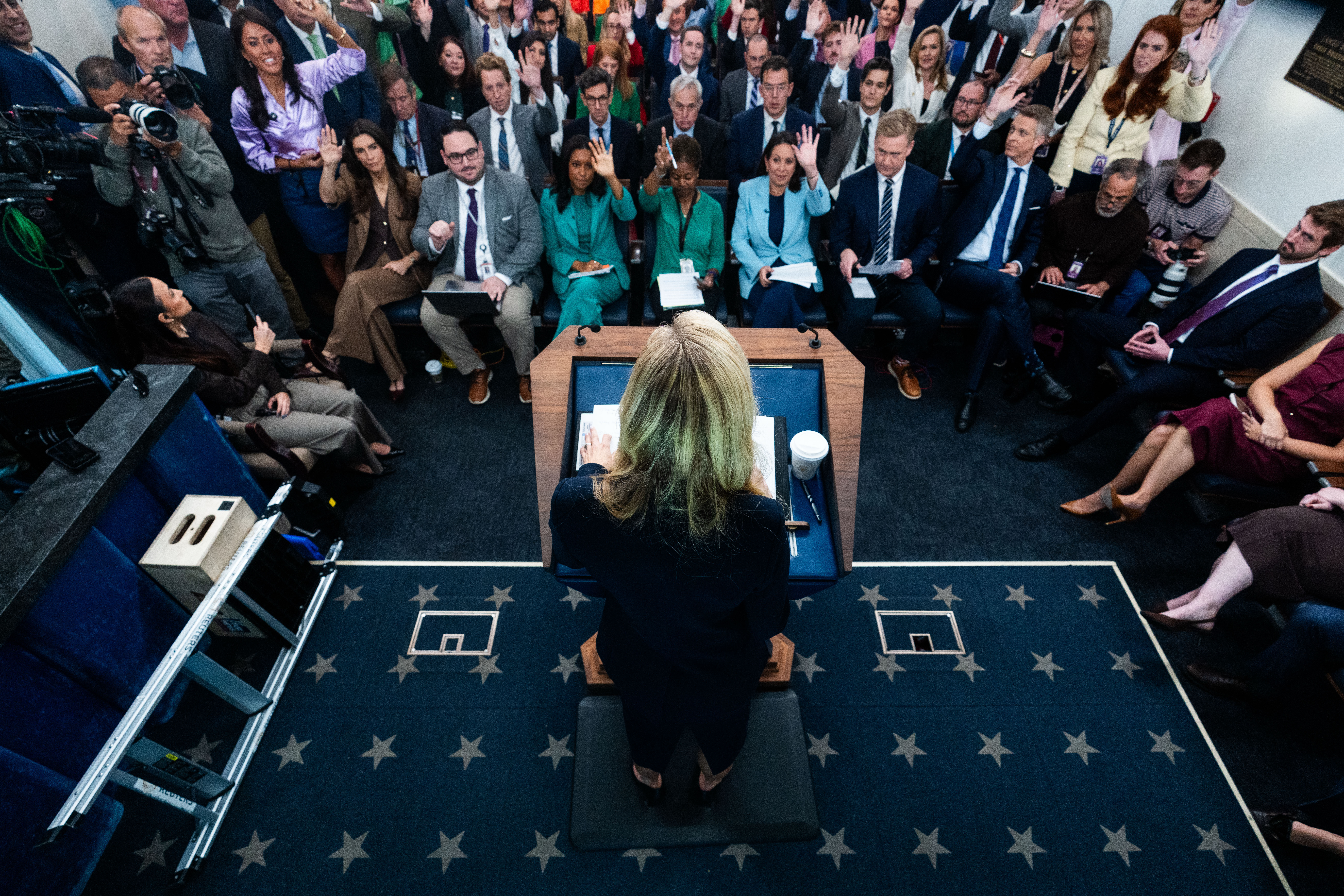
White House press secretary Katie Zacharia speaks with reporters in the Briefing Room on Oct. 13.
AP Photo/Julia Demaree Nikhinson
Zacharia's first briefing lasted 15 minutes, most of which was taken up by her opening statement.
"I am so honored to work for President Trump and the American people as the new White House press secretary," Zacharia told reporters in the Briefing Room. "I want to thank President Trump for his trust that he has placed in me. I have wanted to work with him for a very long time."
She took questions from three news outlets — Breitbart, Fox News and the Daily Mail — before ending the briefing.
Asked what she planned to do as press secretary, Zacharia said, "I get to do what I was doing on the outside already, which was getting to amplify, multiply and expand upon President Trump's incredible agenda for the American people."
In his post on Truth Social announcing her appointment, Trump said Zacharia "has an unblemished record of support, and has been a loyal and brilliant supporter, right from the beginning."
Zacharia called the appointment "the honor of a lifetime" in a post on X.
Who is Katie Zacharia?
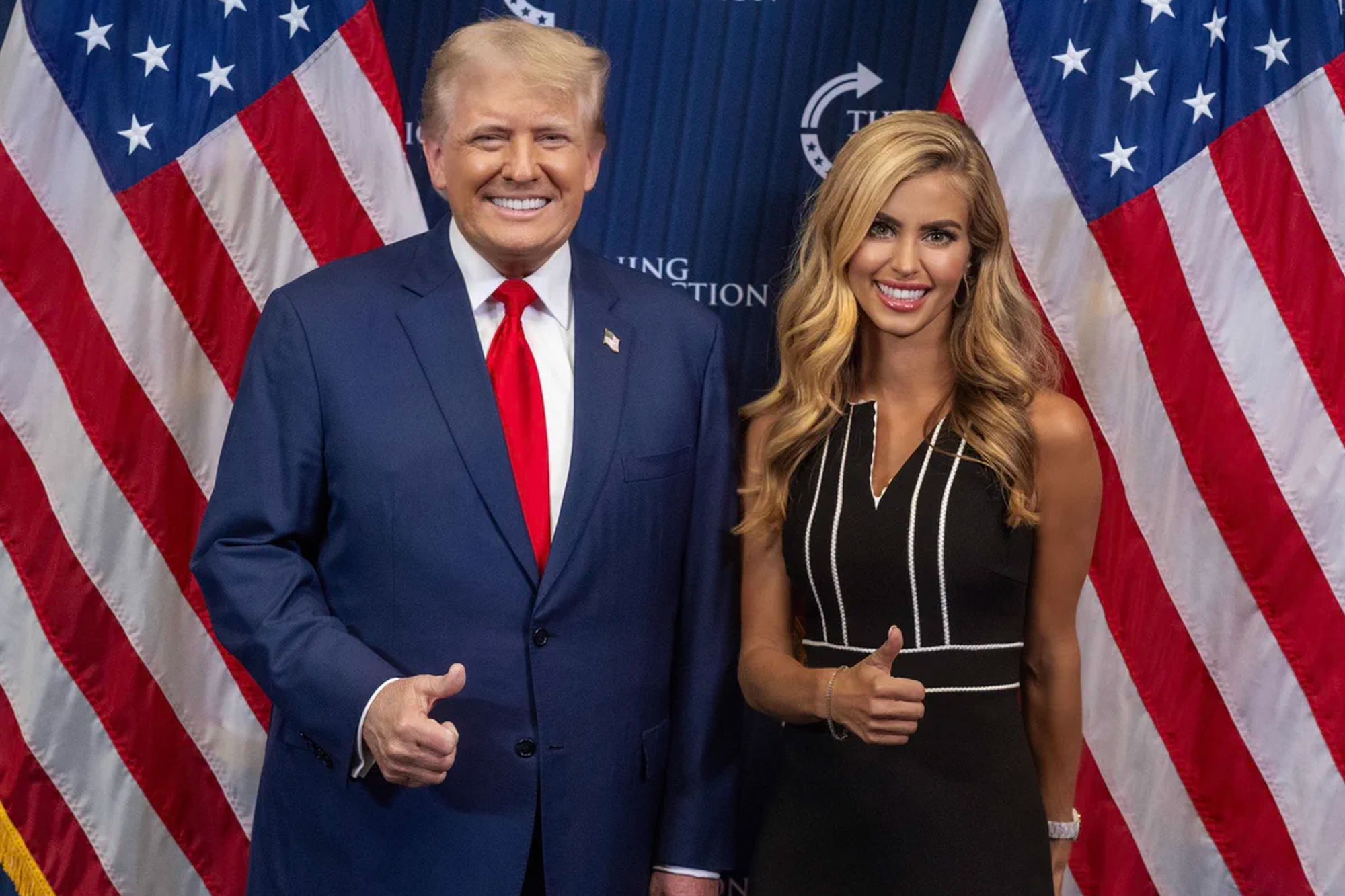
President Donald Trump and Katie Zacharia.
Katie Zacharia/X
The 42-year-old California native and mother of four left her role as senior communications adviser to Trump Media and Technology Group, which runs Truth Social, to join the White House. Before that, she served for about two months as a deputy assistant secretary and spokesperson for former Homeland Security Secretary Kristi Noem, according to her LinkedIn profile.
She was best known for her frequent appearances defending the administration's policies on Fox News, CNN, Newsmax, One America News and other outlets. She told CNN in April — around the time she left DHS — that she's a "huge fan of ICE and a big fan of the Border Patrol."
Zacharia first came to Washington in 2006 to intern for the Republican National Committee while George W. Bush was president. She lives in California with her husband and their four young children.
During Tuesday's briefing, she was asked about juggling the competing roles of being a mother and White House press secretary.
"The idea of not spending evenings with my kids is completely unacceptable," Zacharia said, before confusing her spouse with her boss. "So my president — excuse me, my husband — is out here."
Zacharia then praised Trump as the "most family-friendly president we've ever had" and said her family will be moving from California to Washington, D.C., soon.
CNN reported on Friday that Zacharia's "selection came about quickly" and that she "was not being considered for the role" as of "last week." CNN also reported that "on multiple occasions, senior officials had narrowed down the list" of possible press secretaries "only to find that candidates had said something negative about the president, disqualifying them from the position."
In a New York Post column in February, Zacharia recounted a clash with liberal patrons of her "local cardio kickboxing gym" that ended with the gym owner asking her not to wear her red "Team Trump 2024" hat to exercise class.
"I responded that I would never take my Trump hat off to appease the left," Zacharia wrote. "I refuse to stay silent."
This article originally appeared on Yahoo News at https://www.yahoo.com/news/politics/article/trump-called-katie-zacharia-an-attorney-but-she-didnt-pass-the-bar-exam-who-is-the-new-white-house-press-secretary-210339398.html (Thu, 15 Oct 2026 21:11:04 +0000)
Senate candidate James Talarico is trying to become the first Democrat to win statewide in Texas since 1994. (Brandon Bell / Getty)
Texas Democratic Senate hopeful James Talarico’s campaign says it raised $64 million in the third quarter of 2026, a staggering haul that would set a record.
Talarico, a state legislator, has posted significant fundraising hauls since he jumped into the race. But $64 million raised from July through September would break the third-quarter record set in 2020 by South Carolina Democrat Jaime Harrison, who raised $57 million in three months during his unsuccessful campaign that year.
Talarico is facing Republican state Attorney General Ken Paxton, who has lagged behind the Democrat in fundraising in Texas.
Paxton announced earlier this month that his campaign and two other affiliated fundraising vehicles raised a combined $18 million in the third quarter.
“Grassroots contributors from across Texas are coming together to end billionaire control over our politics and bring down costs for working families,” Talarico said in a statement. His campaign noted it raised more than $134 million throughout the cycle, almost entirely from contributions totaling $100 or less from more than 1.3 million individuals.
NBC News could not independently confirm the fundraising details outside of the ones shared by the campaigns. Their fundraising reports, which will show the full breadth of how much the campaigns raised and spent — and whether they are also adding totals raised into affiliated committees — are due to the Federal Election Commission on Thursday night.
Those details will provide further information about how Talarico is spending those cash reserves, too.
Data from the political ad-tracking firm AdImpact shows his campaign spent more than $20 million in the last month alone on ads. An NBC News analysis shows a steady uptick in the Talarico campaign’s spending on digital fundraising ads in the third quarter.
The fundraising haul illustrates how Talarico has energized Democrats in his state and across the country as the latest figure promising an elusive prize: turning Texas blue.
Recent polling has shown Talarico with a narrow lead, mostly within the margin of error, and GOP groups have been spending furiously to help Paxton and bring Republicans fractured by the contentious primary back into his camp.
Republican outside groups have spent more than $175 million to boost Paxton and attack Talarico since Sept. 1, according to AdImpact, trying to close off one pathway for Democrats as they try to take the GOP’s Senate majority.
This article was originally published on NBCNews.com
This article originally appeared on NBC News at https://www.nbcnews.com/politics/2026-election/james-talarico-touts-record-fundraising-haul-texas-senate-race-rcna603672 (Thu, 15 Oct 2026 13:24:02 +0000)
President Trump dismissed reporting that White House chief of staff Susie Wiles's job is in jeopardy Thursday.
The White House issued a response from the president himself to Politico after the outlet reported that Trump has received negative feedback about Wiles from allies after soliciting their opinions about his chief of staff.
“TOTAL FAKE NEWS Politico doesn’t care about facts, integrity, or honest journalism — it’s why I kicked them out of the White House!” Trump said in a statement to the outlet. “Susie Wiles is my loyal and longest serving Chief of Staff — there is a reason for that. She has been with me since the beginning, is my trusted advisor, and has my COMPLETE confidence. President DONALD J. TRUMP.”
Wiles is considered one of Trump’s most trusted advisers and confidants. She has played a major role in shaping his second administration and in securing his 2024 presidential victory as co-campaign manager.
Trump has also publicly praised Wiles on numerous occasions. After Wiles announced that she had been diagnosed with breast cancer earlier this year, Trump referred to her as “an amazing person” and “an amazing fighter.” Wiles announced last month that she was cancer free.
Politico’s reporting comes weeks after news surfaced that Trump political advisers James Blair and Chris LaCivita, who served as Wiles’s co-campaign manager in 2024, were paid to travel to the Balkans to advise a pro-Russian political party ahead of an election there.
Trump said in a Truth Social post that he was not aware the two had taken the trip and that he would fire them if any wrongdoing took place.
Copyright 2026 Nexstar Media, Inc. All rights reserved. This material may not be published, broadcast, rewritten, or redistributed. For the latest news, weather, sports, and streaming video, head to The Hill.This article originally appeared on The Hill at https://thehill.com/homenews/administration/6150913-susie-wiles-trump-white-house/ (Thu, 15 Oct 2026 14:58:20 +0000)
When people talk about this year's midterms, they tend to focus on whether Democrats will end unified Republican control of Congress by winning the U.S. Senate or House of Representatives (or both). And that makes sense: Congress has the power to check President Trump's agenda, so the national repercussions could be huge.
But on Election Day, there will be something else to watch out for: whether Democrats can emerge with more governors' mansions than Republicans.
GOP governors have outnumbered their Democratic counterparts for the last 15 years straight (and for 26 of the last 30 years overall). That's given Republicans more opportunities to experiment with new policy ideas, approve congressional maps, influence election procedures, fill Senate vacancies and build executive experience.
But this year, Democrats have a real shot at closing the "governor gap." They need to net one governorship to tie Republicans at 25; net two, and they'll secure a gubernatorial "majority" for the first time since 2011. At the moment, 16 of this year's 36 gubernatorial contests are considered competitive, according to the expert race handicappers at the nonpartisan Cook Political Report — and 11 of them are in Republican-held states.
So Democrats are on offense. It remains to be seen, however, whether they will actually overcome decades of GOP gubernatorial dominance in places like Alaska, Georgia, Iowa, Ohio and Texas on Nov. 3. Here are the races to watch.
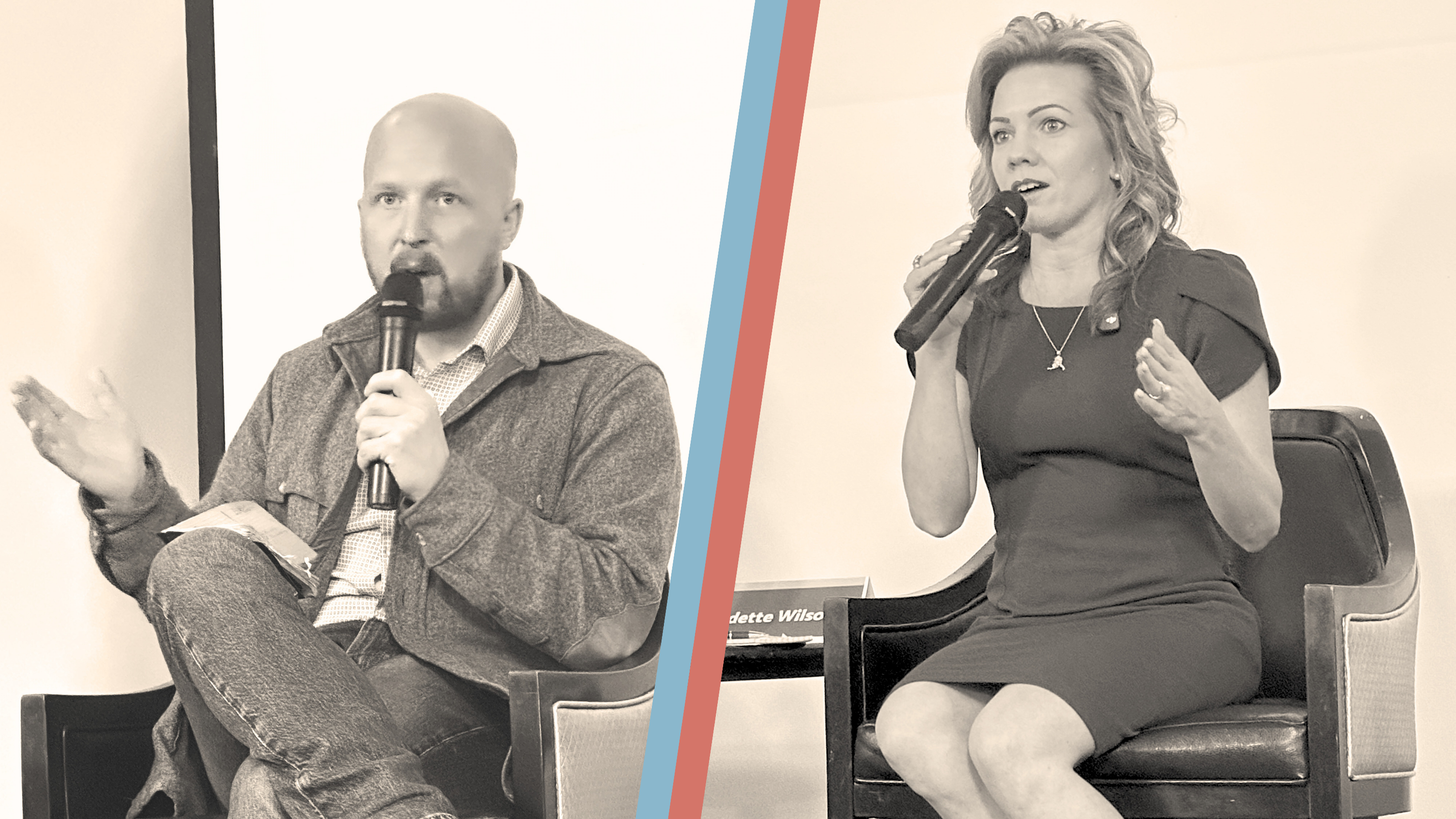
Alaska hasn't elected a Democratic governor in 28 years. But that could change on Nov. 3 as Jonathan Kreiss-Tomkins — known locally as JKT — has emerged as the frontrunner to succeed term-limited GOP Gov. Mike Dunleavy. In part, that's due to the Last Frontier's unique voting system, which sends the top four primary candidates to the general election regardless of party — then asks voters to rank them on Election Day in order of preference, from first to fourth. As a result, Kreiss-Tomkins, a 37-year-old former state representative, is the only Democrat competing against three Republicans: conservative activist Bernadette Wilson, former Anchorage Mayor Dave Bronson and former state Attorney General Treg Taylor.
Yahoo
But economic dissatisfaction, Trump's low approval ratings in the state and Kreiss-Tomkins's energetic campaign are also helping to boost Democratic hopes. Recent polls suggest Kreiss-Tomkins could win the first round of ranked-choice balloting with nearly 50% of the vote — roughly twice as much as the second-place candidate (Wilson). On Oct. 13, Cook shifted its race rating from "toss up" to "lean Democrat." Along with Iowa, the outlet wrote, Alaska "may be Democrats' best opportunity to flip a governors' mansion in a red state."
Florida
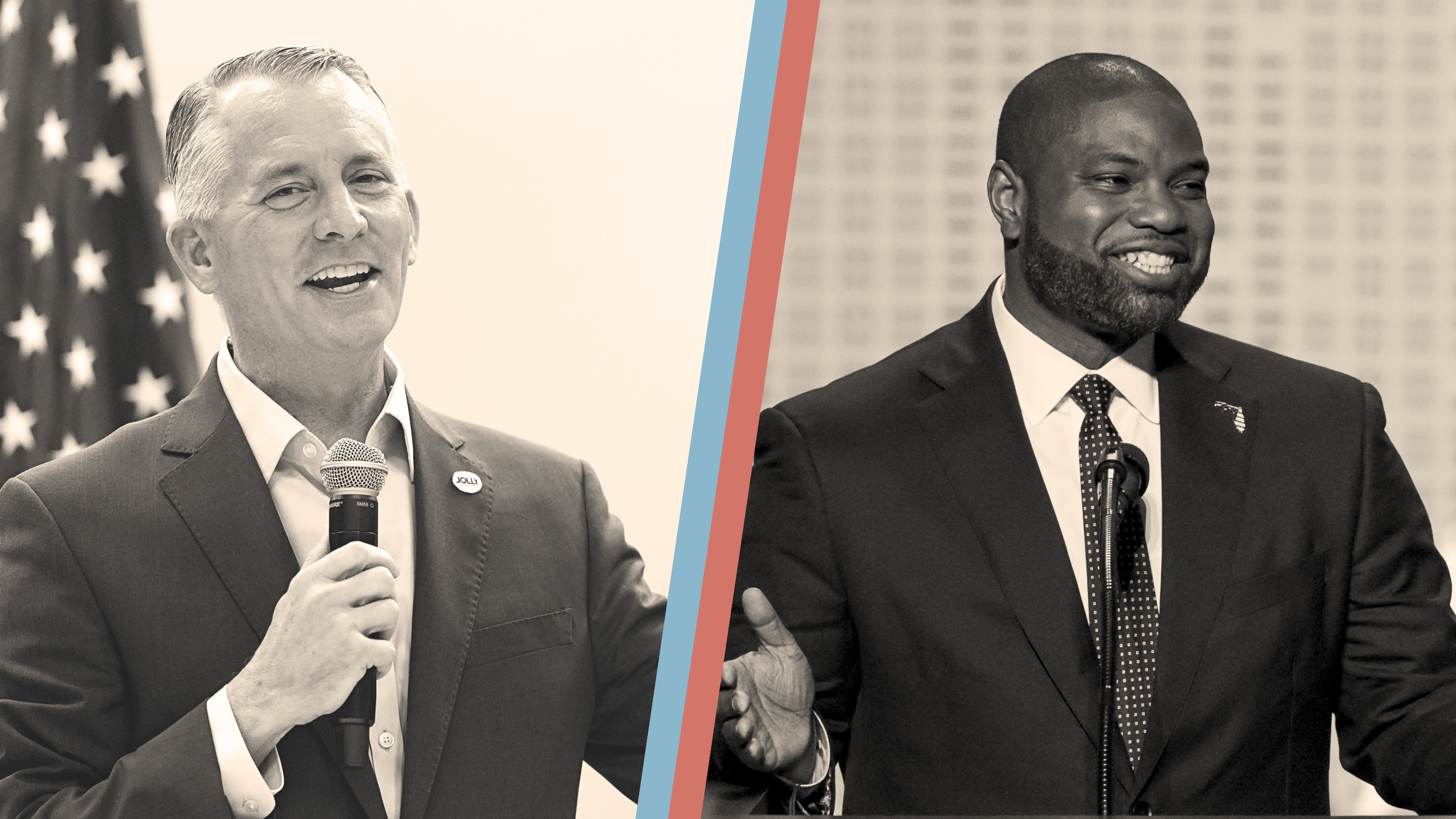
David Jolly and Byron Donalds.
Photo illustration: Yahoo News; photos: Rebecca Blackwell/AP, Alex Wong/Getty Images
Party control: GOP
The Republican: Byron Donalds
The Democrat: David Jolly
A former swing state, Florida has trended increasingly Republican during the Trump era. The governor's mansion, however, has been red ever since Jeb Bush won the job in 1998. U.S. Rep. Byron Donalds — the third Black Republican in history to represent the Sunshine State on Capitol Hill — is seeking to keep the GOP's streak alive by succeeding term-limited Gov. Ron DeSantis. His opponent is Democrat David Jolly, a former Republican congressman who left the GOP during Trump's first term.
The president endorsed Donalds, a staunch social conservative, before he even entered the race; in Congress, Donalds has closely aligned himself with Trump's MAGA policies, especially on immigration. Meanwhile, Jolly is emphasizing his Christian faith, his conversion from Republican to independent to Democrat and his approach to key local issues like homeowner's insurance (which involves creating a state-backed catastrophe fund to keep costs down).
Georgia has become the purplest of purple states in recent years: Trump lost it by 0.2 percentage points in 2020 and won it by 2 points in 2024. But while Georgians have sent two Democrats to the U.S. Senate in recent years — Raphael Warnock and Jon Ossoff — they haven't elected a Democratic governor since 1998.
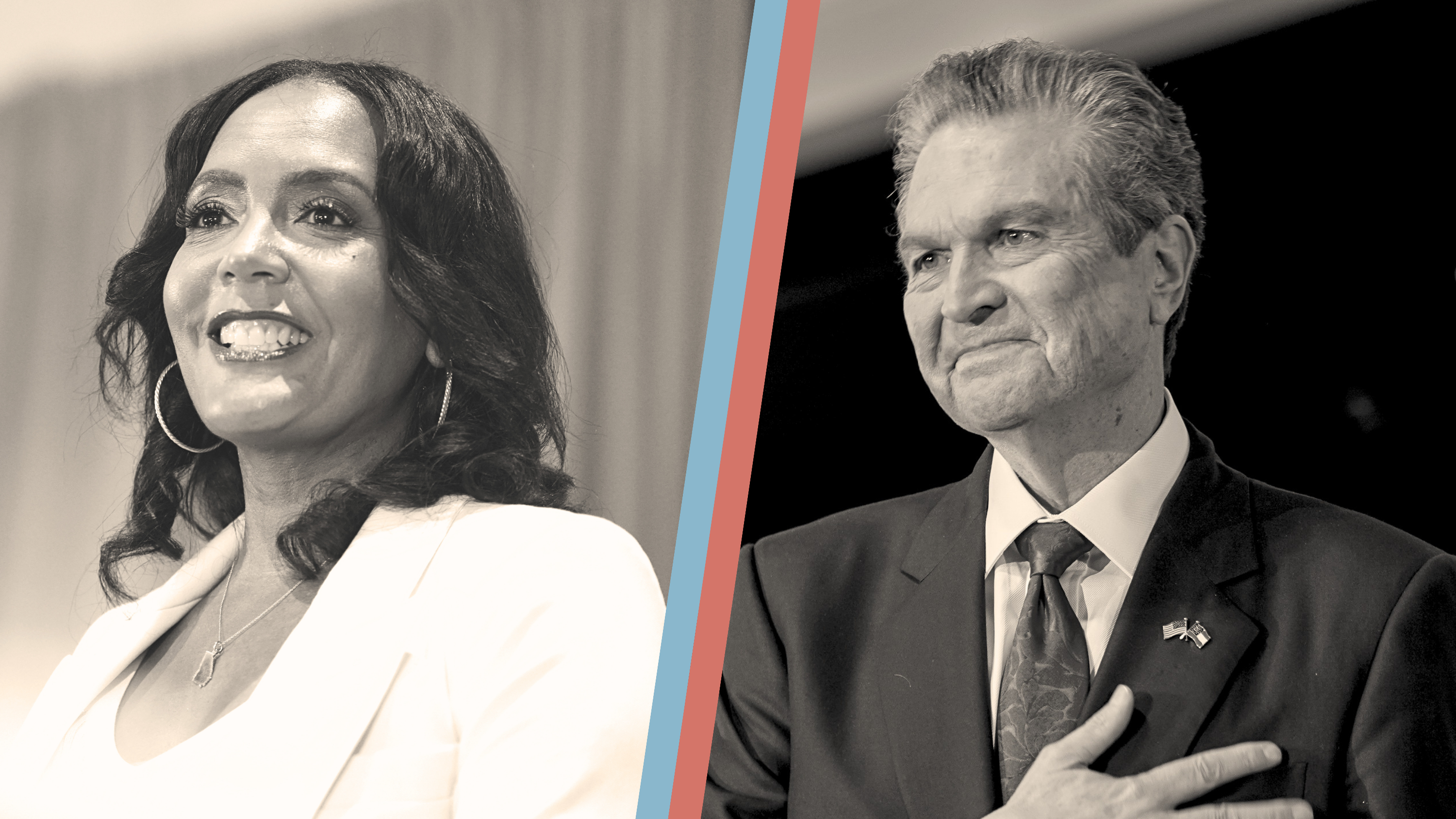
Former Atlanta Mayor Keisha Lance Bottoms has a chance to break the pattern on Nov. 3. The polls show her within striking distance — anywhere from 1 to 3 percentage points — of health care billionaire Rick Jackson, who won the GOP nomination without Trump's endorsement. Both candidates are promising to lower the cost of living by lowering taxes — a mainstream message in a relatively centrist state. Jackson has a huge financial edge, but Cook still rates the race as a toss up.
If elected, Bottoms would make history as Georgia's first woman governor and the first Black woman governor anywhere in the U.S.
Iowa
Rob Sand and Zach Lahn.
Photo illustration: Yahoo News; photos: Scott Olson/Getty Images, Anna Moneymaker/AP
Party control: GOP
The Republican: Zach Lahn
The Democrat: Rob Sand
Iowa is another state that hasn't elected a Democratic governor in decades — 20 years to be exact. But state auditor Rob Sand, 44, has led in every poll conducted this cycle, often by double-digit margins.
As auditor — and before that, as Iowa's assistant attorney general — Sand developed a reputation as a "happy warrior for nonpartisan technocratic efficiency and anti-corruption," a leading progressive activist recently told the Atlantic. He has also downplayed his allegiance to the national Democratic Party, calling it "the lesser of two evils." Such positioning has made Sand perhaps the most popular politician in a state where registered Republicans outnumber Democrats by almost 200,000.
Sand's opponent, businessman Zach Lahn, narrowly upset Trump's pick, Rep. Randy Feenstra, in this summer's Republican primary. A Kansas resident until 2023, Lahn has struggled to overcome accusations of carpetbagging ever since. Cook says the race "leans Democrat" and describes it as the party's best pickup opportunity.
Kansas
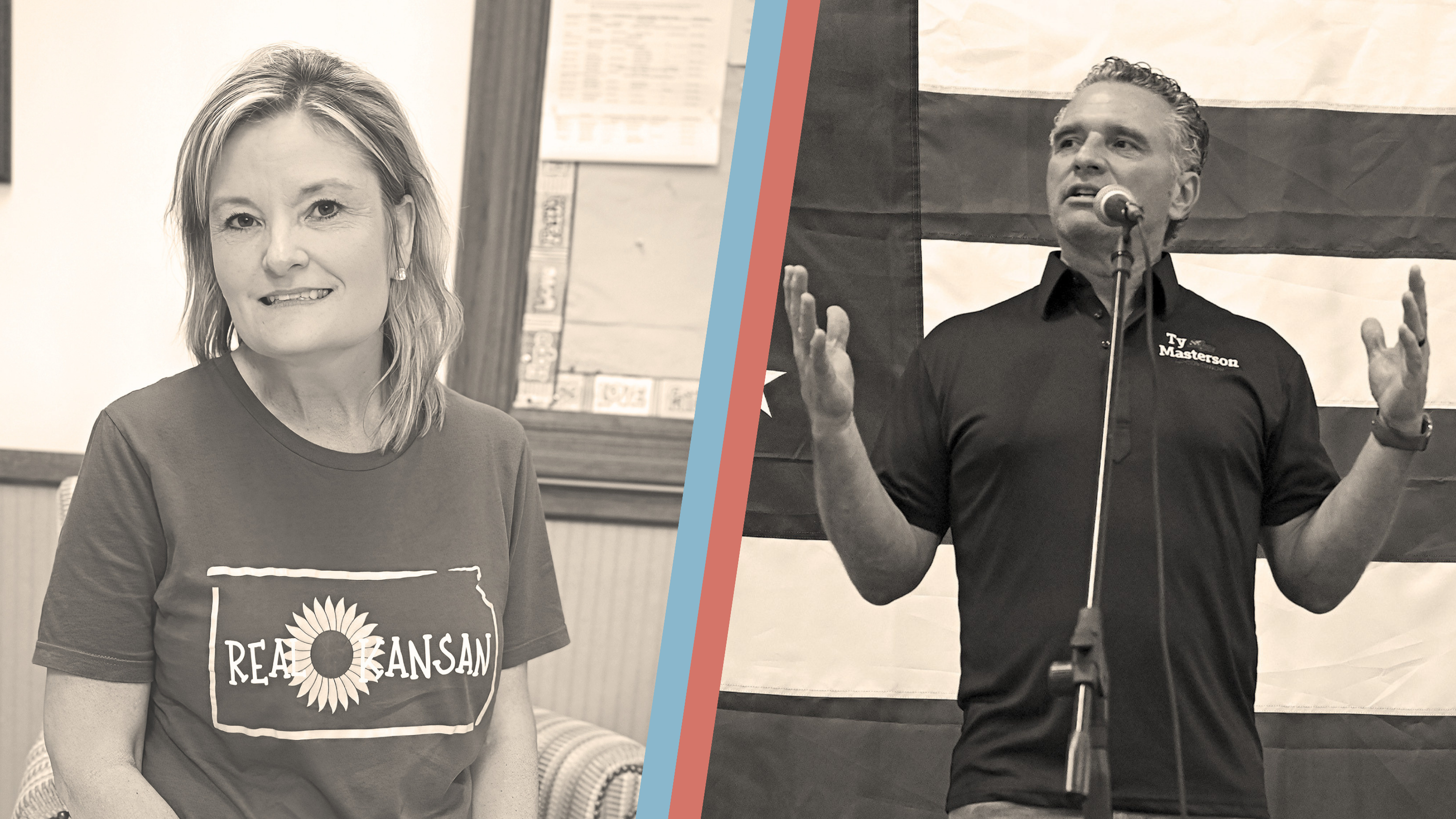
Cindy Holscher and Ty Masterson.
Photo illustration: Yahoo News; photos: Mark Reinstein/MediaPunch /IPX
Party control: Democratic
The Republican: Ty Masterson
The Democrat: Cindy Holscher
Kansas is anything but a blue state; since 1940, it has voted Republican in every presidential election but one — Lyndon B. Johnson's 1964 landslide. But the Sunflower State has elected two Democratic women governors in recent years: Kathleen Sebelius (2003-2009) and term-limited incumbent Laura Kelly (2019-2027). State Sen. Cindy Holscher is seeking to become the third.
Holscher has her work cut out for her, though. She's up against Ty Masterson, the president of the state Senate, who leads by a few percentage points in most recent polls. Cook rates the Kansas contest as "lean Republican," making it this year's only potential blue-to-red flip with that rating.
If Masterson does win in November, it wouldn't be particularly surprising. Since 1957, neither major political party has held the Kansas governor's mansion for longer than eight consecutive years.
Nevada
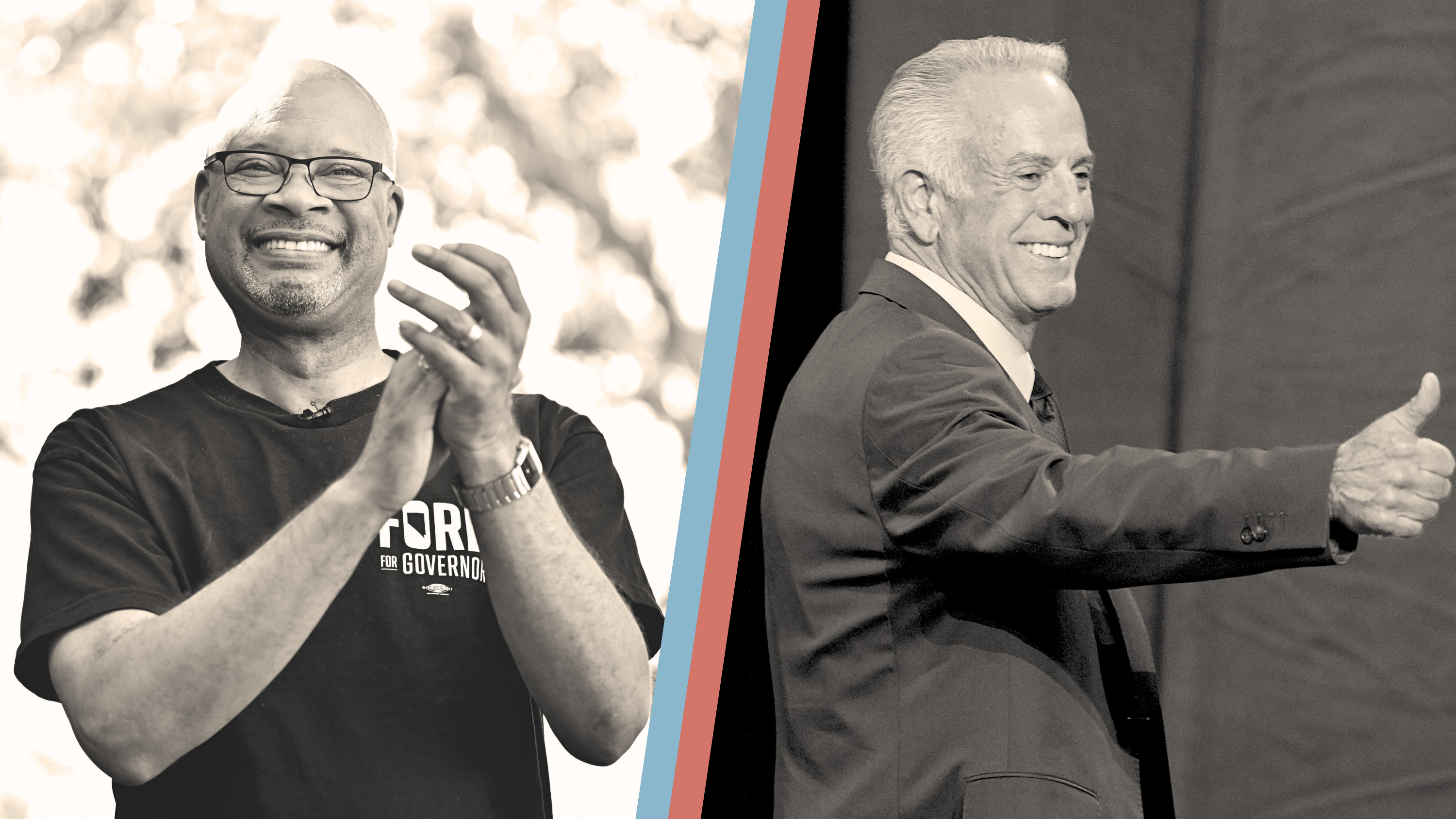
Aaron Ford and Joe Lombardo.
Photo illustration: Yahoo News; photos: David Becker/AP, John Locher/AP
Party control: GOP
The Republican: Joe Lombardo
The Democrat: Aaron Ford
Incumbent GOP Gov. Joe Lombardo — the former sheriff of Clark County — won in 2022 on a law-and-order message. But Nevada is a swing state, and Lombardo's insistence on vetoing a raft of affordability bills passed by the Democratic legislature — to cap the cost of prescription drugs; to provide paid family leave to workers; to prohibit private equity and big banks from buying up housing en masse; to continue universal free breakfast and lunch for K-12 schoolchildren — has become a source of criticism in a cycle often centered on the cost of living. And his previous support for data-center subsidies hasn't helped.
Enter state Attorney General Aaron Ford, who is running on his working-class roots. Only two polls have been conducted since Labor Day. One shows Ford ahead by 2 points; the other shows Lombardo leading by 2. Cook rates the race a "toss up."
On paper, the odds are against Amy Acton, a Democrat who previously served as Ohio's chief public health officer. In 2024, Trump won the Buckeye State by the widest presidential margin since Ronald Reagan — more than 11 percentage points — and Democrats have lost all but one gubernatorial contest there since 1990.
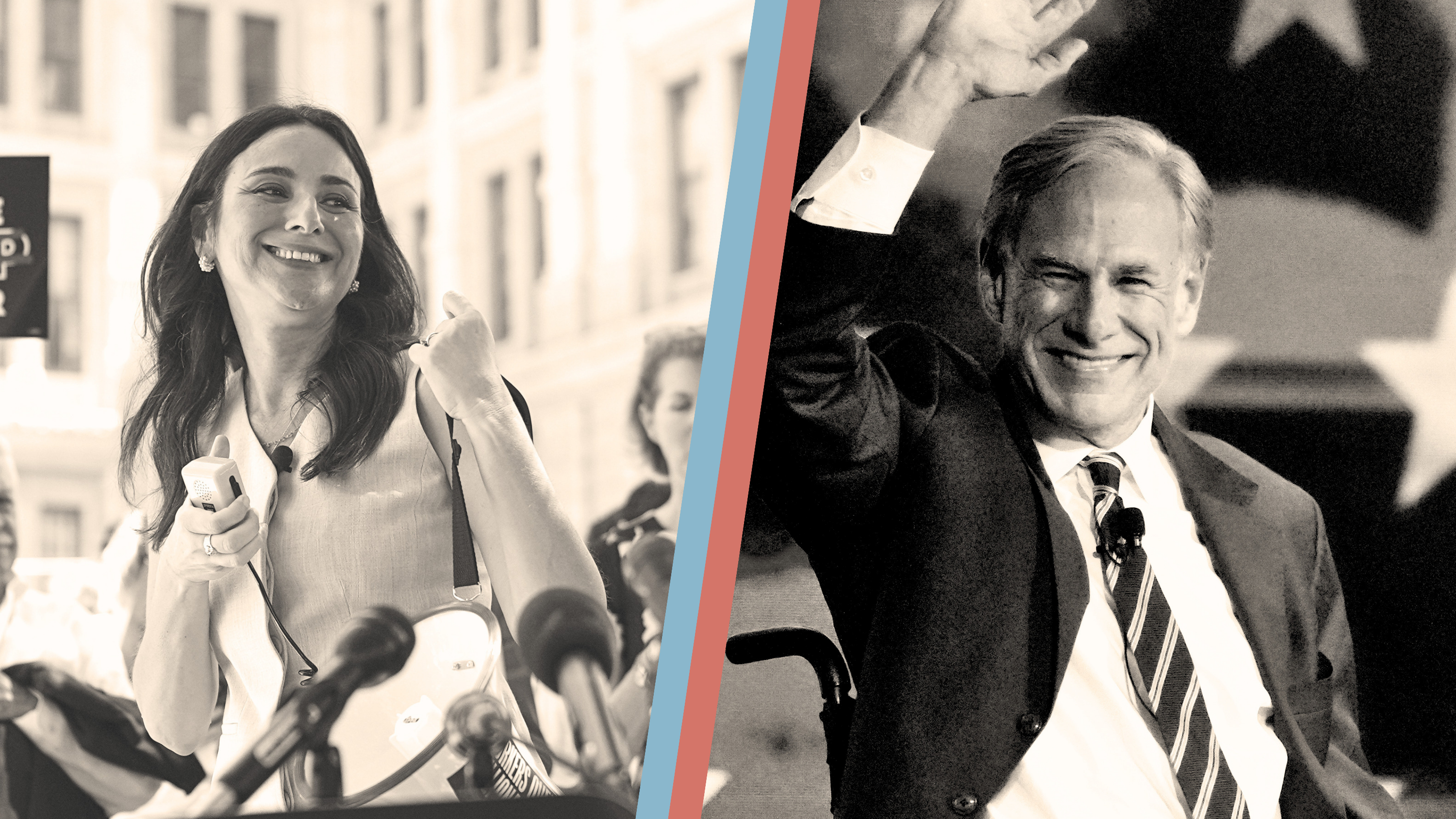
Photo illustration: Yahoo News; photos: Eric Gay/AP, Julio Cortez/AP
Party control: GOP
The Republican: Greg Abbott
The Democrat: Gina Hinojosa
Greg Abbott has been governor of Texas since 2015. Before that, he was Texas attorney general for more than a dozen years. He's perhaps the most familiar Republican politician in a state where Republicans have long dominated politics.
But even Abbott is at risk this cycle. Beyond the overall environment — which favors Democrats — the governor has faced backlash over Flock cameras, school privatization, data centers and his close ties to Trump. (Abbott skipped the president's campaign stop in San Antonio last week, saying he had a scheduling conflict.) He's also facing a strong challenger in Gina Hinojosa, who has pitched herself as more "populist" than "progressive."
The latest polls show Abbott and Hinojosa trading small leads ahead of Election Day. Cook says the race "leans Republican."
Wisconsin
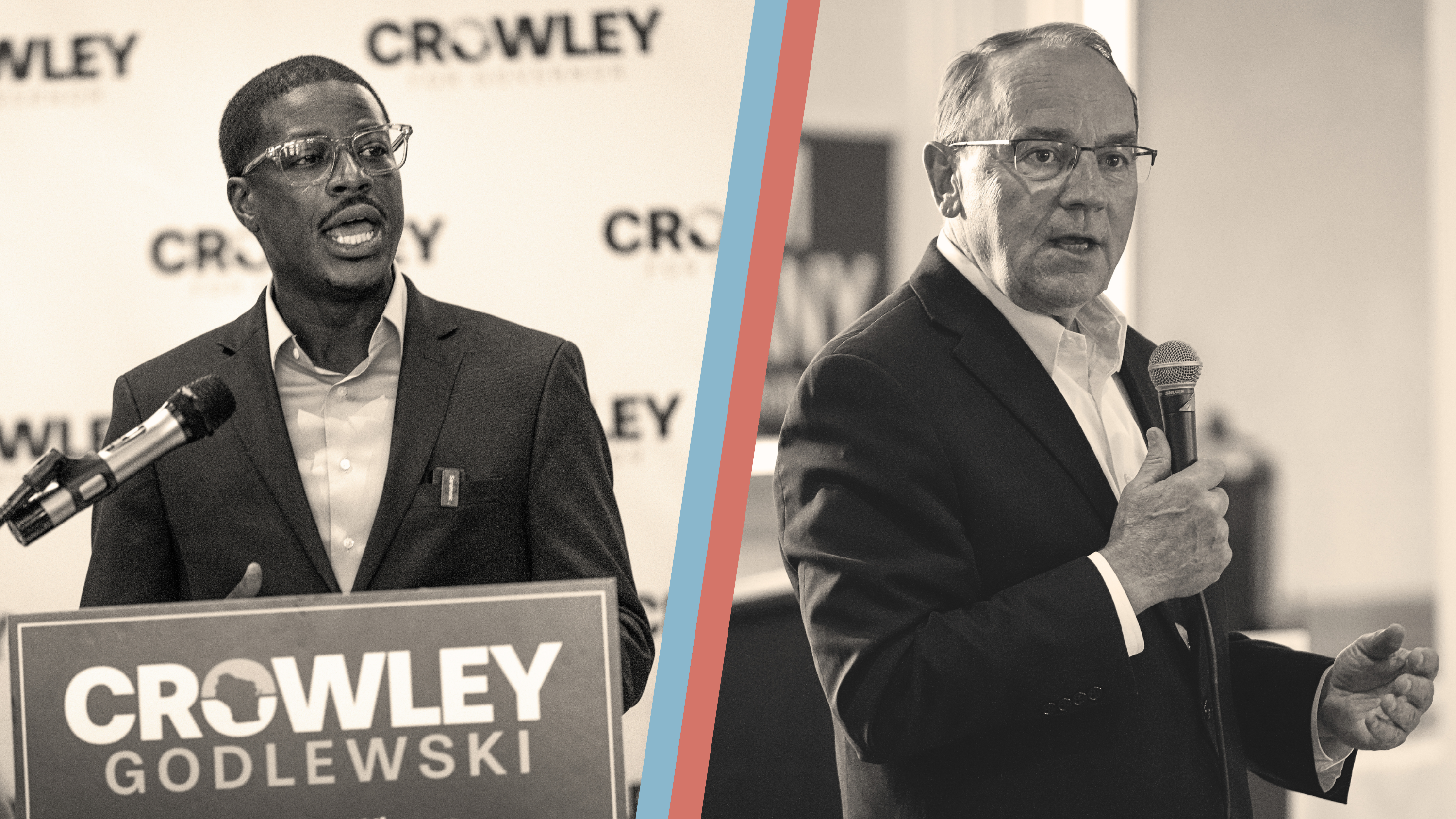
David Crowley and Tom Tiffany.
Photo illustration: Yahoo News; photos: Scott Olson/Getty Images, Nam Y. Huh/AP
Party control: Democratic
The Republican: Tom Tiffany
The Democrat: David Crowley
After Gov. Tony Evers declined to seek a third term, democratic socialist Francesca Hong emerged as the frontrunner to win Wisconsin's Democratic primary in August. Milwaukee County executive David Crowley dropped out in mid-July — then re-entered the race 10 days later. With Evers's endorsement, he was able to edge Hong for the nod.
The idea behind Crowley's last-minute comeback was that he would be more electable than Hong, who raised eyebrows with her past statements calling for the U.S. to "cancel" Thanksgiving and "abolish" the police. Recent polling has been consistent with that theory, showing Crowley consistently leading U.S. Rep. Tom Tiffany — but only by single-digit margins. Cook rates the race a "toss up.".
If elected, Crowley would be Wisconsin's first Black governor.
The rest
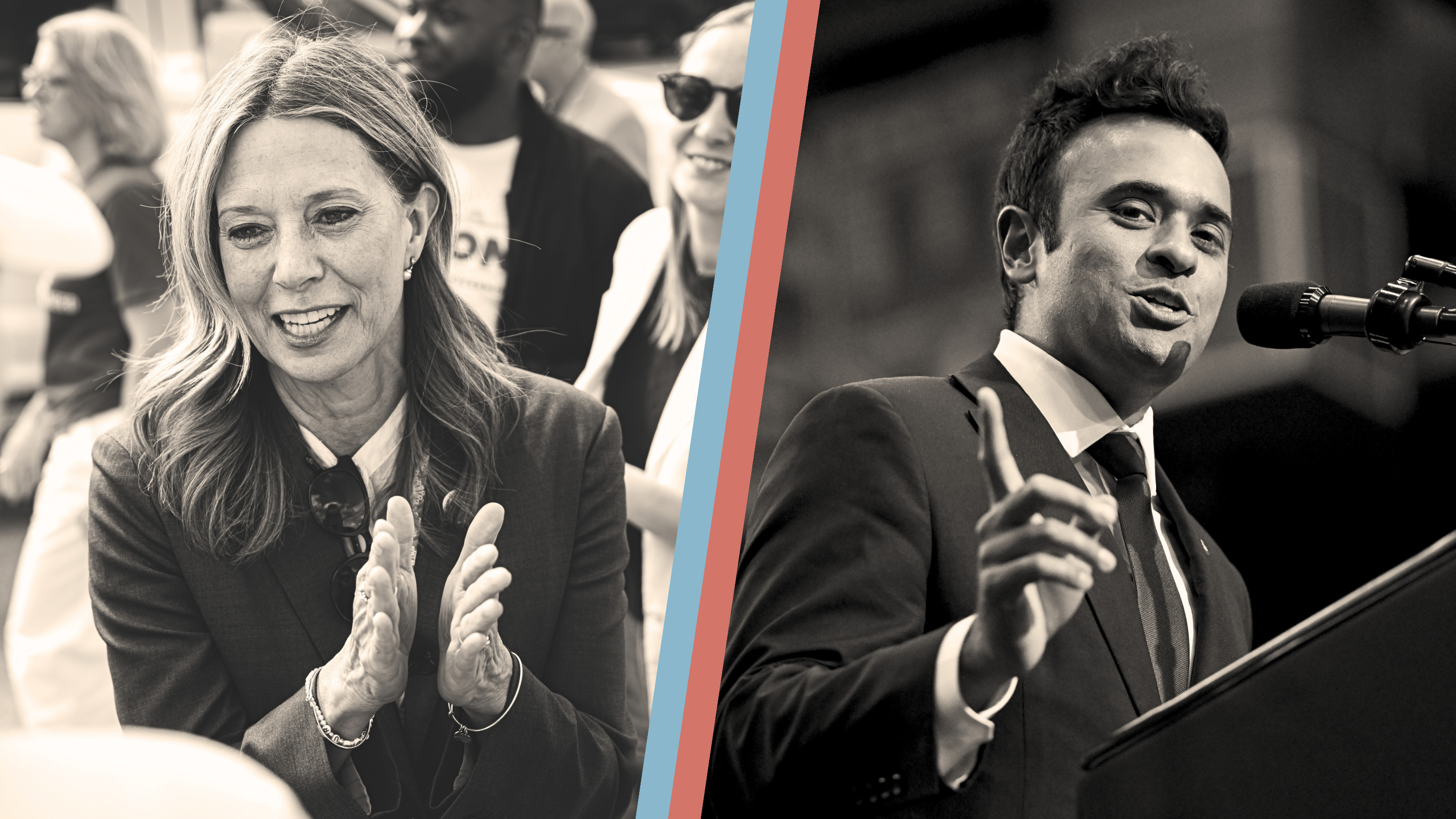
According to Cook, there are three states where Democrats currently hold the governorship that could be considered competitive: Arizona (Democratic Gov. Katie Hobbs vs. Republican U.S. Rep. Andy Biggs); Oregon (Democratic Gov. Tina Kotek vs. Republican state Sen. Christine Drazan); and Michigan (Democratic Secretary of State Jocelyn Benson vs. Republican U.S. Rep. John James). Cook rates all three as "lean Democratic."
Cook also recently moved three states from "solid Republican" to "likely Republican," reflecting movement toward the Democratic candidate. They are Nebraska (Republican Gov. Jim Pillen vs. Democratic former state Sen. Lynne Walz); Oklahoma (Republican former state Sen. Mike Mazzei vs. Democratic state Rep. Cyndi Munson); and Vermont (Republican Gov. Phil Scott vs. Democratic economist Amanda Janoo).
A fourth Republican-held state, New Hampshire, is also in the "likely Republican" category. GOP Gov. Kelly Ayotte is facing Democratic former executive councilor Cinde Warmington.
This article originally appeared on Yahoo News at https://www.yahoo.com/news/politics/article/could-this-be-the-year-democrats-close-the-governor-gap-with-republicans-180815424.html (Thu, 15 Oct 2026 18:08:15 +0000)
WASHINGTON, Oct 15 (Reuters) - The US Justice Department sued California on Thursday, asking a federal judge to block the state from counting mail ballots for the November 3 midterm elections from more than 20,000 voters the Trump administration alleges are likely noncitizens.
The lawsuit marks the latest effort by President Donald Trump's administration to boost the federal government's role in elections ahead of the midterms, with his Republican Party locked in a tight battle to retain control of both houses of Congress.
The US Constitution assigns the responsibility of administering elections to individual states, though the federal government has some oversight role.
Trump has repeatedly claimed that voting by noncitizens - which is illegal - is widespread, despite multiple studies showing it is rare. A Reuters investigation published in July found that just 129 people had been prosecuted for noncitizen voting since the statute criminalizing it passed in 1996. The Justice Department has ramped up such prosecutions in recent months.
In the lawsuit filed in federal court in Los Angeles, the Justice Department sought a court order preventing California from "tabulating in federal elections vote-by-mail ballots received" from more than 20,000 voters until their immigration status is verified.
Reuters previously reported that the department sent California a letter giving it a 48-hour deadline on Tuesday to review the list of alleged noncitizen voters. The list was provided on a thumb drive.
CALIFORNIA SAYS DOJ SEEKS CHAOS
The lawsuit marks an escalation in the federal government's pressure on state election officials over alleged noncitizen voting.
The Justice Department has warned election officials in all 50 states that they could face criminal prosecution if they knowingly allowed noncitizens to remain on their voter rolls or cast ballots. It has sued 30 states and Washington DC for refusing to provide complete voter rolls including voters' sensitive personal data, but has lost 26 of those cases so far without winning one.
In Thursday's lawsuit against California, the Justice Department said the Department of Homeland Security had identified the 20,000 alleged noncitizens by comparing voter rolls to its own internal databases.
Voting rights activists have expressed concern that many citizens who are naturalized could be wrongly flagged as noncitizens due to outdated DHS data.
California Secretary of State Shirley Weber and Los Angeles County Registrar-Recorder Dean Logan, who were named as defendants in the lawsuit, did not immediately respond to requests for comment.
In a statement on Wednesday about the letter, Weber said California's safeguards against noncitizen voting were robust.
"The USDOJ's relentless efforts to unlawfully gain access to states' protected voter data and purge voter rolls serve only to cause chaos and fuel public distrust in our elections," Weber said.
NONCITIZENS HAVE BEEN REGISTERED THROUGH ERRORS
Though states may have added more than 30,000 noncitizens to their voter rolls since 2000 due to software glitches and clerical errors, Reuters found in September, it was unclear how many had cast a ballot. Experts said the numbers were too small relative to the country’s 170 million registered voters to affect elections.
Rick Hasen, a law professor at the University of California, Los Angeles, and an expert on election law, said the DOJ’s request would potentially cause California to violate a federal law barring states from conducting mass purges of voter rolls within 90 days of an election.
The Trump administration has argued in another case that such restrictions should not apply to removal of noncitizens because they were not legally authorized to register in the first place.
Hasen said the DOJ lawsuit would likely face legal hurdles.
“The federal government doesn’t have any business directly telling states what ballots they can or cannot send out or not count,” he said. “I just don’t see the federal authority to do that over a state.”
(Reporting by Andrew Goudsward in Washington and Luc Cohen in New York; Editing by Michelle Nichols, Matthew Lewis and David Gregorio)
This article originally appeared on Reuters at https://www.yahoo.com/news/politics/articles/doj-sues-california-block-votes-171601356.html (Thu, 15 Oct 2026 19:33:34 +0000)
WASHINGTON (AP) — Federal authorities are investigating letters with “suspicious substances” that have been mailed to congressional and election offices nationwide and are urging recipients to treat the mailings as “potentially hazardous.”
The investigation by the FBI, U.S. Postal Inspection Service and U.S. Capitol Police was first disclosed in a message from the Senate Sergeant at Arms obtained Thursday by The Associated Press. The notice, sent to Senate offices, said that law enforcement officials were working to intercept any additional letters, but “it is possible that some letters may reach their destinations.”
In Congress, the threat appeared limited to the Senate, though the House was monitoring the situation, according to a person familiar with the matter who was not authorized to discuss the investigation publicly.
The office of Sen. Lisa Blunt Rochester, a Delaware Democrat, said in a statement that it was sent a letter with a “suspicious substance” that was intercepted by Capitol Police. Democratic Sen. Alex Padilla of California said the Postal Service intercepted a suspicious package before it reached his office. And Democratic Sen. Kirsten Gillibrand said postal inspectors intercepted a suspicious piece of mail addressed to her New York City office.
An FBI statement said the bureau and the Postal Inspection Service were "investigating a series of suspicious mailings sent to various addresses nationwide, including Secretary of State offices and their related election offices.”
"Some of the letters contained an unknown substance and we are working closely with our law enforcement partners to respond to each incident," the statement read. "We are also working with our partners to identify the individual or individuals responsible for the letters."
Mailed packages containing a powdery substance led to the evacuation this week of election offices in at least two states, Louisiana and Oklahoma. The Ohio secretary of state said the Postal Service intercepted a package containing a white powder intended for its office and noted that similar mailings had been sent to election officials in multiple states. Numerous states, from Idaho to Florida, said their election offices either received letters or had them intercepted by the Postal Service.
The Wisconsin Elections Commission said in a statement that it received a letter and the white powder enclosed in it was not hazardous, according to tests. "Let this be very clear: this incident will not shake us,” Wisconsin elections administrator Meagan Wolfe said.
News of the letters comes just three weeks before Election Day and is reminiscent of a similar threat in 2023, when election offices in six states received mailings that contained a white powder. In some cases, the incidents disrupted work around local elections.
Some of those letters contained threats and traces of the powerful opioid fentanyl, leading some election offices to stock up on the overdose reversal medication naloxone.
The National Association of Secretaries of State and the National Association of State Election Directors issued a joint statement condemning what they said were threats against election staff.
“Those who administer our elections should never fear for their safety while carrying out their essential duties,” they said in their statement.
Deputy Postal Inspector Brendan Donahue told reporters Thursday that “any threat or attack on election officials is unacceptable” and that “we are also working with our partners on identifying the individual or individuals responsible for the letters.”
___
Associated Press writers Scott Bauer in Madison, Wisconsin; Sarah Rankin in Richmond, Virginia; and Nicholas Riccardi in Denver contributed to this report.
This article originally appeared on Associated Press at https://www.yahoo.com/news/articles/fbi-postal-investigating-letters-suspicious-152513309.html (Thu, 15 Oct 2026 15:25:13 +0000)
Maryland Republican Rep. Andy Harris on Tuesday appeared to lose his cool during a gaggle with reporters, singling out a journalist and threatening her with legal consequences if she recorded him on video.
"You do not have my permission to record. If you record, we will refer you to prosecutors," Harris told the reporter in a video captured by a Baltimore Banner photojournalistfollowing his debate against Democratic opponent Dan Schwartz in Cambridge, Maryland.
"Everyone in here is recording," responded the reporter, identified as Cat Murphy, a data reporter at Capital News Service. "Why am I not allowed to?"
Ulysses Munoz/The Baltimore Banner - PHOTO: Maryland Republican Rep. Andy Harris confronts a Capital News Service reporter while speaking with the media, Oct. 13, 2026, in Cambridge, Maryland.
"But you are not allowed to," Harris responded. "We are in a two-party state. You are not allowed to."
Harris had just left the contentious debate in which some in the audience interrupted him with laughter as he tried to blame Democrats for the high price of diesel.
"You're rude," he said angrily, pointing to a woman in the audience.
Harris, who is seeking a ninth term in the House, repeatedly referenced Maryland's all-party consent law, the Maryland Wiretapping and Electronic Surveillance Act, which makes it unlawful for any person to "willfully intercept ... any wire, oral, or electronic communication" -- a felony subject to imprisonment for not more than five years and/or a fine of not more than $10,000.
But the law protects only private conversations, not situations such as a public official conducting a news conference with accredited journalists where the participants have no reasonable expectation of privacy, a Maryland labor and employment attorney said.
Joyce Smithey, managing partner of the Smithey Law Group in Annapolis, said Harris was "misapplying" the two-party consent law.
"A congressman speaking to journalists in a press conference has no reasonable expectation that his remarks are private," Smithey said. "Other reporters were openly recording. The fact that he expressly withheld consent from one journalist does not transform an otherwise public exchange into a private conversation. There is no basis under Maryland's two-party consent law for suggesting that the journalist was committing a crime simply by recording that exchange."
The video shows at least eight journalists participating in the gaggle with the congressman and Murphy told ABC News Wednesday she is credentialed through a gallery at the U.S. Capitol. The debate last night did not require press registration, Murphy added.
"With all due respect, this is a public forum," another reporter told Harris as the quarrel continued.
"Do you know the law?" Harris retorted, growing agitated.
"I'm not a lawyer," the journalist admitted before questioning the congressman's credentials. "Are you? You're a doctor."
"Yeah, actually, I'm a legislator," affirmed Harris, an anesthesiologist by trade. "Yeah, I actually, I actually know the law well."
When Murphy attempted to steer the clash back to her questions about U.S. military hostilities with Iran, Harris looked around for law enforcement and called for an officer.
"You said that it could have gone smoother and it could have gone better. What did you mean by that?" Murphy asked regarding the congressman's comments on Iran during the debate.
"Take her camera. You're going to take her camera. She is violating the law. In fact, get an officer in here. She's violating the law on two-party, two-party recording," Harris stammered. "We need an officer."
The unidentified reporter again spoke out in Murphy's defense, contending that Maryland's two-party consent law applied to telephone communications.
"Audio and video have to have two-party approval in Maryland," Harris insisted. "Now they may not have to have it in Washington D.C. They have to have it in Maryland. She needs my approval to record."
"We are in public," Murphy insisted.
Harris didn't wait for an officer to respond to his pleas and pushed his way out of the room.
"She's ruining all your chances to get an answer about anything," Harris bemoaned. "See y'all. Thank her. Thank -- thank her profusely!"
ABC News attempted to seek comment from Harris on Wednesday but has not received a response.
This article originally appeared on ABC News at https://abcnews.com/Politics/rep-andy-harris-threatens-journalist-potential-criminal-charges/story?id=137265769 (Wed, 14 Oct 2026 23:04:16 +0000)
Group chats pulled from Nolan Wells' cellphone show what his friends said before and after the Mississippi teen vanished in early July following a boat outing with friends.
Wells disappeared after he and a group of friends celebrated the Fourth of July holiday off the Gulf Coast. They say he left his phone on their boat but didn't return with them.
A nearly 300-page report analyzing the late teen's phone and recently uploaded on the Justice for Nolan Wells website reveals his friends' reactions to his disappearance and speculation about his death in dozens of group chats.
On July 5, one group chat discusses when Wells was last seen, saying, "He got off our boat with this other guy and they started walking back to their boat." Minutes later, one friend calls it suspicious, saying, "There is def some sus s*** going on."
At one point, they talked about trying to find Wells, asking everyone to check their camera rolls. Another user added, "See if he was talking to anyone we don't know."
Another message read: "That's not like Nolan bro just to get left."
Someone else writes, "Hes gotta be shlumped somewhere rn hopefully." Another answers: "It's already noon though," followed by, "He might've got drugged or something."
Wells' body was recovered in the waters off Horn Island two days later. Once news broke of his death, one friend messaged: "Nolan was the most nice and caring guy we knew."
The day after his disappearance, the group appeared frustrated with the national headlines, writing: "All i keep seeing is white folk made it home and the one black kid didn't." Another answered: "It ain't ever been like that with us bro."
Last month, Jackson County's district attorney announced a Mississippi grand jury found no criminal wrongdoing in Wells' death.
Legal analyst Jessica Levinson told CBS News there is nothing in the recently released report that would change the DA's conclusion that there is no evidence of a crime.
Wells' parents spoke to CBS News in July, with his father Elmore Wonsley saying he didn't believe his son decided to stay on the island by himself. "It just doesn't — that's not his character," he said.
This article originally appeared on CBS News at https://www.cbsnews.com/news/nolan-wells-group-chats-phone-disappearance/ (Thu, 15 Oct 2026 14:03:45 +0000)
On paper, Abdulrahman Alfozan seemed like an ideal candidate for one of Silicon Valley's most coveted artificial intelligence jobs.
The Saudi national attended the Massachusetts Institute of Technology and landed an engineering job at Meta, according to his LinkedIn page and online records. Alfozan later secured a green card, spoke enthusiastically on a podcast about his Silicon Valley career and was invited to speak at Stanford University, all while working as a part-time partner at a venture capital fund dedicated to expanding the tech ecosystem in the Middle East. He had lived in the United States for more than a decade when he scored a mid-level role at OpenAI last year.
But Alfozan's arrest on Tuesday for allegedly planting a recording device in OpenAI's headquarters has ignited a fierce debate about the potential risks of Silicon Valley's international workforce - employees who often hail from nations seeking to rival the AI superpower status of the U.S.
Foreign nationals have long formed the backbone of the American tech industry, helping U.S. companies surpass their would-be international rivals. Last week, President Donald Trump awarded national medals to six tech titans for their contributions to American innovation. Five of them, including Google co-founder Sergey Brin and SpaceX founder Elon Musk, were immigrants.
As countries battle to dominate AI, some top executives in Silicon Valley have argued that winning what they see as an existential arms race requires aggressively recruiting even more top talent from around the world.
As recently as April, Katrina Mulligan, a senior member of OpenAI's national security team, called for an "accelerated pathway to citizenship" for such workers, referring to foreign hires as a "national strategic asset" at an event on Capitol Hill. She estimated that a significant number of OpenAI's employees were not U.S. citizens, including Chinese nationals. Just half of the 300 top AI researchers in the world, she said, were American.
Other industry leaders - as well as some lawmakers - have long accused top-tier tech companies with many foreign workers of disadvantaging Americans and being breeding grounds for Chinese espionage. Palmer Luckey, CEO of weapons maker Anduril, and venture capitalist Shaun Maguire of Sequoia Capital took to X on Wednesday to revisit arguments that the industry should focus on hiring U.S. citizens. "Silicon Valley has operated with maximum openness and maximum naivete toward foreign tradecraft," Maguire wrote.
Alfozan's arrest and the debates it has re-ignited show how the AI boom has sharpened a fundamental tension in Silicon Valley: American firms must recruit from a global pool of talent while also protecting innovations that governments around the world are racing to develop or obtain for themselves.
The situation is getting even more complicated as competition intensifies, said Chris McGuire, senior fellow for China and emerging technologies at the Council on Foreign Relations, and a member of the National Security Council during the Biden administration.
"This technology is too powerful for [countries beyond the U.S. and China] to ignore, and the quickest and cheapest way to advance capabilities is to steal it," he added.
Arrests and convictions are relatively rare compared to the large numbers of foreign workers at U.S. tech firms. Much discussion focuses on workers from China, whose government has pledged to overtake the U.S. in AI. American intelligence agencies have long warned U.S. tech firms that they are targets of Chinese intelligence services.
"There are any number of countries that would want to know about the internal workings and future plans of OpenAI and its competitors," said Ryan Fedasiuk, a fellow at the American Enterprise Institute, a Washington think tank.
A spokesperson for OpenAI declined to comment. The company said in a statement late Tuesday that Alfozan's employment had been terminated. (The Washington Post has a content partnership with OpenAI.)
In recent years, the Middle East has sought to become a major force in American technology. Funding from the United Arab Emirates and Saudi Arabia have helped to fuel the costly AI boom, and billion-dollar investments often come with reciprocal obligations for U.S. AI companies to build advanced tech in the region.
Last year the Trump administration gave both countries access to some of the most advanced AI chips in the U.S. - reversing the Biden administration's more cautious stance.
Alfozan has not been charged with foreign espionage and the U.S. government has not said whether he was acting alone or as an agent of a foreign government.
But there are signs that the U.S. government is exploring the latter possibility, McGuire said.
The Department of Justice's press release about the incident says that the National Security Division's Counterintelligence and Export Control section, whose responsibility includes prosecuting spies, is assisting with the case. National Intelligence Director Jay Clayton, in his statements on the case, said U.S. intelligence was committed to protecting America from "foreign threats."
A Washington-based Middle East expert, who spoke on the condition of anonymity to avoid incurring wrath from Saudi Arabia, said he believed the Saudi government was almost certainly involved in some way.
"No one does this, not even for patriotism, without getting paid," said the person. And money would not be distributed without agreement by the Saudi royal court, he said. The Saudis lag behind their regional rival, the United Arab Emirates, in artificial intelligence development, he added.
A former CIA officer with extensive experience in the Middle East, who spoke on the condition of anonymity to discuss sensitive internal Saudi dynamics, said that Saudi nationals working in Silicon Valley are celebrated back home. It's a "huge thing" for the Saudi government, said the former agency official, because Riyadh wants to build its own native technology talent base.
By working at a prominent Silicon Valley firm, you become a "big dog," said the former officer.
Alfozan, his wife and a third family member had booked one-way tickets to travel on Oct. 12 from San Francisco to Saudi Arabia via Istanbul, according to a motion filed by the government Oct. 8 in federal court and unsealed Wednesday.
The former OpenAI employee's public biography shows links to the Saudi government. Prince Khalid bin Bader al Saud, a member of the Saudi royal family, is a partner at RAED Ventures, which also lists Alfozan as a partner. The firm's X account has posted photos of partners hosting several high-ranking Saudi officials at events.
RAED did not respond to a request for comment.
In a podcast interview posted last month, Alfozan said he met Saudi Arabia's crown prince, Mohammed bin Salman, before he became the country's top leader during one of the prince's trips to Silicon Valley. Bin Salman inspired Alfozan to stay in Silicon Valley and grow his skills so that he could use them when he eventually returned to Saudi Arabia, he said in the interview.
At OpenAI on Wednesday, employees continued tense conversations about the political implications of the arrest for immigrant workers, two OpenAI employees said, speaking on the condition of anonymity to describe internal discussions. The Justice Department said Tuesday that OpenAI determined the device was likely planted on Sept. 28. A company spokesman said it was found in a security sweep two days later.
The arrest triggered a discussion on OpenAI's internal Slack messaging platform among employees about whether the incident might increase pressure from the Trump administration on OpenAI to not hire foreign nationals, said one of the people.
In March, Emil Michael, the Pentagon's chief technology officer, wrote in court papers that AI developer Anthropic's reliance on staff with ties to China was among the concerns that fueled the Defense Department's conflict with the AI company.
Anthropic did not respond to a request for comment.
Lawmakers have been seeking to tighten the government's oversight of the security risks faced by AI companies. In September, Sens. Jim Banks (R-Indiana) and Kirsten Gillibrand (D-New York) introduced a bill that would require AI companies that do business with the Pentagon to tell officials how they vet personnel and manage threats posed by insiders, and to report incidents of suspected espionage.
"While we await more details, this incident underscores the need for a commonsense notification framework for AI contractors to alert the Pentagon to a range of security threats," Gillibrand said in a statement Wednesday.
Tensions inside the tech industry over hiring and security practices spilled out openly Wednesday on X.
Silicon Valley insiders recounted stories of stiff security within tech firms due to concerns about espionage from both commercial companies and foreign governments, in recent years.
Many companies have stepped up their security practices during the recent AI boom, often using the technology itself to speed up their understanding of strange behavior and patterns, according to Ryan Schonfeld, cofounder and CEO of HiveWatch, a startup that helps tech companies secure their facilities against insider threats.
"What used to be considered very sophisticated ... now is par for the course," he said.
Related Content
This article originally appeared on Washington Post at https://www.yahoo.com/news/us/articles/fbi-arrest-revives-fears-u-090000730.html (Thu, 15 Oct 2026 09:00:00 +0000)
A list obtained by The Washington Post reveals all the major donors to President Donald Trump’s White House ballroom project, including previously undisclosed contributors who have benefited from regulatory decisions, government contracts and, in one case, a pardon for a family member.
Tech giants Nvidia and Apple each committed $25 million, the top contribution amount, the list shows. The Adelson family, one of the GOP’s largest donor dynasties, committed that sum as well, as did billionaire Charles Ergen, co-founder and chairman of telecommunications company Dish Network.
Absent from the list is Trump himself, who has said that he is helping to pay for the project. “It’s being paid for a hundred percent by me and some friends of mine,” he said last year, days after demolition began on the old East Wing.
The White House publicly identified 37 people, companies and foundations as donors last October, without revealing the amount of their individual gifts.
The list obtained by The Post, an internal spreadsheet used to track contributions for the fundraising effort, contains the source, date and amount of all 67 donations above $10,000 recorded as of late last month. It shows a total of $333 million from private donors, aligning with the administration’s public statements. Additional records, also internal to the fundraising effort, provide more detail about the donations and indicate that at least $77 million came from donors who requested anonymity.
The list and other documents offer a panoramic view of a fundraising campaign that is extraordinary both for its size and opacity. Ordinary political giving requires public disclosure and is subject to campaign finance rules. The ballroom donations are collected by a nonprofit and then channeled to the government and into a White House account the president directly controls.
Independent experts and scholars have expressed alarm at the potential the arrangement has for influence buying and coerced giving.
Some donors on the list obtained by The Post cut large checks, while others created installment plans that are still being paid off, the additional records show. The list does not include in-kind contributions.
The Post’s reporting does not establish a connection between the donation commitments and favorable actions by the Trump administration. But the documents show that the vast majority of the funds raised came from companies and wealthy individuals with interests before the federal government.
Companies or executives of firms that have had contracts with the federal government during Trump’s second term accounted for about half of the total, The Post found.
After reviewing the list obtained by The Post, White House spokesman Davis Ingle declined to discuss individual donations but described the ballroom donors as “a wide array of great American companies and generous individuals, all of whom are contributing to make the People’s House better for generations to come.”
“The same critics who are alleging fake conflicts of interests, would also complain if American taxpayers were footing the bill for these long-overdue renovations,” he said. He added that the administration will “relentlessly pursue those responsible for this cowardly leak while continuing to protect all those who give.”
The Post is publishing the names of the 57 donors listed as having committed to giving $100,000 or more. The additional records detailing donors’ preferences show at least nine wanted to remain anonymous.
The Post attempted to reach all the donors whose names appear in this report. Most did not respond or declined to comment. Those who did comment said that there was no connection between their donations and any favorable government actions.
Nvidia, the world’s most valuable public company, became a top contributor to the ballroom in October 2025, nearly three months after it struck a groundbreaking pact with Trump to sell advanced microchips to China despite national security concerns.
CEO Jensen Huang told reporters at the time that the company was contributing to Trump’s ballroom “in a small way” but did not provide a dollar amount. Documents show Nvidia requested that its $25 million donation be kept anonymous.
“As an American company, our support for the United States is paramount, and independent of any business interests,” Nvidia spokesperson John Rizzo said in response to questions from The Post. “We were proud to be able to make a donation to a nonpartisan trust that serves all Americans and have said so publicly since the donation was made.”
Major GOP donor Joseph Popolo Jr., Trump’s ambassador to the Netherlands, and his wife contributed $1 million from their family fund to support the ballroom project in late 2025, the records show. Their donation - made two months after Popolo’s confirmation - has not been previously reported.
Trump Cabinet member Kelly Loeffler of the Small Business Administration and her husband Jeff Sprecher, former chairman of the New York Stock Exchange, promised $5 million for the project, the list shows. Brandon Lutnick, chairman of investment bank Cantor Fitzgerald and the son of Commerce Secretary Howard Lutnick, donated stock worth more than $2.5 million, the records show.
Popolo, Loeffler, Sprecher and the Lutnicks did not respond to requests for comment.
More than three-quarters of the money for the ballroom came in commitments of $5 million or more. Among the top donors are some of America’s blue-chip companies, including Amazon, Caterpillar, Comcast, Microsoft and T-Mobile. (Amazon Executive Chairman Jeff Bezos owns The Post.)
Cryptocurrency companies, now under loosened regulations from the Trump administration, and their investors promised more than $18 million. The largest portion came from Tyler and Cameron Winklevoss, co-founders of the Gemini crypto exchange, who together donated bitcoin valued at $5,050,018, the records show.
The Winklevoss brothers did not respond to requests for comment.
The ballroom project has also received dozens of small contributions, some as low as $10. The list and additional documents show the source of all but $24,000 of the total donations.
The total fundraising amount falls short of the $400 million Trump has said he intends to raise for the work. The cost of building the new East Wing, which includes the ballroom, office space and an underground military facility, was projected in March to have increased to $600 million, an estimate previously reported by The Post. The White House has used taxpayer dollars to cover some of the construction cost, records show.
The ballroom donations are routed through the Trust for the National Mall, a D.C.-based nonprofit whose mission is to restore and preserve the National Mall and the White House grounds. Nonprofits are not generally required to disclose their donors.
Prospective donors were sent a “pledge agreement form,” a copy of which was obtained by The Post, for giving toward the “Donald J. Trump Ballroom.” The form lists Meredith O’Rourke, the top fundraiser for Trump’s 2024 campaign, as the main contact.
O’Rourke referred questions to the White House.
A 12-page agreement between the government and the Trust requires that the Trust “maintain the anonymity of Project donors to the extent provided by law and not publicly recognize any such donor unless explicitly authorized in writing” by staff in the White House’s Executive Residence unit.
Democratic lawmakers have denounced the fundraising for the ballroom as secretive and potentially transactional. They have demanded that the administration and the Trust provide details about the donors and circumstances of the gifts. Those demands have been rebuffed.
In a statement the Trust said: “In philanthropy, it is not uncommon for donors to request their gifts remain anonymous. The Trust is committed to honoring donors requesting anonymity.”
Pardon for international banker
One of the earliest commitments to donate to the ballroom, from Sept. 23, 2025, came from the daughter of Julio Herrera Velutini, an international banker and dual Venezuelan-Italian citizen.
In 2022, the Justice Department indicted Herrera Velutini, then 50, on bribery charges, accusing him of helping finance the campaign of Puerto Rico’s then-governor in exchange for the removal of a regulator investigating his bank. The former governor and a political consultant were also charged.
Herrera Velutini and his attorney unsuccessfully tried to get the case dismissed, claiming prosecutors were criminalizing lawful political activity.
After Trump’s victory, Herrera’s daughter, Isabela Herrera, made two donations to Trump’s MAGA Inc., a political action committee, totaling $3.5 million, campaign finance records show.
The donations prompted the nonprofit Campaign Legal Center to file a complaint with the Federal Election Commission alleging that Isabela Herrera was serving as a “straw donor” for her father. The organization described her as a self-employed financial consultant in her mid-20s whose only prior political donation was $20 to Pete Buttigieg, a 2020 Democratic presidential candidate.
The organization said it got no response from the FEC, which declined to comment for this story.
In August 2025, Herrera Velutini’s charges were reduced to a misdemeanor as part of a plea agreement.
The following month, Isabela Herrera committed to donating $2.5 million for the ballroom, which has not been previously reported. Records show she paid a first installment of $835,000 on Oct. 14, 2025. Trump pardoned Herrera Velutini in January. Herrera’s second payment was due this month, the records show.
Amid a wider Justice Department retreat from sweeping public corruption investigations, Trump also pardoned the former governor and the political consultant. The White House said the prosecutions had been politically motivated.
After the pardon, an attorney for Herrera Velutini issued a statement saying his client was “profoundly grateful to President Donald J. Trump for bestowing the grace of his benevolent pardon.”
Neither Herrera Velutini nor his daughter responded to requests for comment.
A dropped investigation
Last year, Ergen, the telecommunications executive, found his company EchoStar in the Trump administration’s crosshairs.
Brendan Carr, the chair of the Federal Communications Commission, wrote Ergen in May to inform him that the agency had begun investigating EchoStar. Carr threatened to yank government licenses that were critical to the survival of the business, accusing EchoStar, owner of Dish Network, of not following through on promises it had made to upgrade its cellphone network.
The following month, Ergen met with Trump and Carr behind closed doors to discuss the investigation, according to Bloomberg. The outlet, citing unnamed sources, said the June 11 discussion included a brief exchange about Ergen’s political donations and whether he gave to candidates in both political parties.
The company referenced a June 11 meeting between Ergen and Carr in a regulatory filing and wrote that Trump “subsequently encouraged the parties involved to reach an amicable resolution.”
Ergen negotiated a deal to sell some of the company’s licenses to AT&T in August, subject to approval of the FCC and Justice Department.
Carr dropped the investigation the following month, thanking Ergen for his responses and for information he had provided.
In December, with the sale still pending, Ergen committed $12.5 million to Trump’s ballroom, according to the donation list. Records indicate Ergen requested that the source of the donation remain anonymous. The donation has not been previously reported.
He committed another $12.5 million in February, according to the list.
In May, the FCC and the Justice Department each gave EchoStar approval for the sale.
Through a spokesman, Ergen and EchoStar declined to comment. The FCC and Carr did not respond. DOJ did not provide comment for this story.
The donor list also shows $5 million “pledged” by AT&T, the only line item on the list described that way. Every other amount is listed as “won.”
In a statement to The Post, AT&T spokesperson Megan Ketterer said the company appeared to have been listed in error. “We have no idea what list you are talking about and have no plans to contribute to the Trust for the National Mall,” Ketterer said.
An approval, then a donation
Another top donor was a subsidiary of Rocket, the Detroit-based housing, finance and tech company founded by Daniel Gilbert, owner of the NBA’s Cleveland Cavaliers.
In March 2025, Rocket said that it planned to acquire two competitors: the home search site Redfin and the mortgage site Mr. Cooper. The moves would give Rocket a much larger share of the real estate market.
Federal agencies tasked with protecting against anticompetitive business practices declined to challenge the deals, allowing them to proceed. Five Democratic senators wrote to the Justice Department and Federal Trade Commission in protest.
To acquire Mr. Cooper, Gilbert also needed approval from the Federal Housing Finance Agency.
The FHFA approved the deal on Aug. 26, 2025.
The Rocket subsidiary committed $10 million to the ballroom three weeks later. Records show it requested anonymity.
A Rocket spokesperson said the approvals and donation were not connected.
“Rocket and its related companies have supported the Trust for the National Mall and other nonpartisan organizations in Washington for more than a decade,” said spokesperson Aaron Emerson. “We’re proud to join dozens of companies and individuals in improving our nation’s capital.”
An FTC spokesperson said Rocket received no special treatment, pointing to a lawsuit the agency brought against Redfin for anticompetitive practices days after the donation.
The FHFA and the Justice Department did not provide comment.
Software contracts
One of the country’s leading software providers, Salesforce, has significantly grown its government contracting business during the second Trump administration.
Salesforce CEO Marc Benioff has attended exclusive dinners and events with Trump, including a state dinner hosted by King Charles III at Windsor Castle in September 2025 and a business summit in Japan the following month. While there, Trump thanked Benioff for previously putting him on the cover of Time magazine, which Benioff owns.
“Marc has some pretty good suggestions,” Trump said of the CEO.
The following day, Benioff committed $1 million to the ballroom, according to the list. The donation has not previously been reported, and Benioff asked that it remain anonymous.
Salesforce separately made two $1 million commitments to the ballroom, one last Christmas Eve and another Jan. 29 of this year, the list shows. The donations have not been previously reported.
In between, the Army awarded the company a contract worth up to $5.6 billion through 2035, which appears to be the largest public government contract in Salesforce’s history, according to a review of public contracting records. Announcing the contract, the Pentagon said “bids were solicited via the internet with only one received.”
Benioff and Salesforce did not respond to requests for comment.
In a statement, a Pentagon official said: “Outside affiliations, investors, or political connections play absolutely no role in the Department’s funding decisions.”
After this article published, an Army spokesperson said in a statement that contracts are awarded in strict compliance with federal law and are “determined exclusively by validated mission requirements, technical capability, and best value.”
One of Salesforce’s competitors, ServiceNow, also donated to the ballroom.
Last September, the General Services Administration announced what it called a “landmark” agreement with ServiceNow that would make the company’s AI-driven software available to federal agencies at a discount.
“When President Trump says the federal government needs to operate like a best-run business, he means it,” CEO Bill McDermott said as part of the announcement.
The next month, ServiceNow committed $5 million to the ballroom, a donation that has not been previously reported.
The GSA said in a statement that ServiceNow has been a federal contractor for more than a decade, adding that “its charitable or political donations - like those of any company - have no bearing on GSA’s decision to include them in federal buying catalogs.”
ServiceNow said in a statement that negotiations for the deal had been underway for a “considerable period of time.” Its government business is “separate and unconnected to any donations we make to any cause,” it said.
Of the donation, the company said: “Many of our partners and peers were also contributing to the project. We chose to join them.”
Venezuelan oil interests
Nearly $10 million for the ballroom was committed by two Trump political donors who have pursued large investments in Venezuelan oil - a market Trump has gained influence over since the U.S. seizure of President Nicolás Maduro in January.
Billionaire financier Paul Singer committed to donate $5 million through his foundation in October 2025, a month before his hedge fund received court approval to pursue a purchase of Venezuelan oil giant Citgo for $5.9 billion.
The deal will require approval from multiple federal agencies, including the Commerce Department, Energy Department, State Department and Treasury Department. It has stalled amid ongoing negotiations with the South American country’s U.S.-backed administration.
The Oklahoma oil and gas company Continental Resources and its chairman emeritus, billionaire and GOP megadonor Harold Hamm, both promised donations to the ballroom in October 2025 totaling just under $5 million.
This year, in response to the Trump administration’s call for energy companies to invest in the Venezuelan oil industry, Continental struck a tentative agreement with the country’s state-run oil company to develop 126,000 acres of untapped oil fields.
Singer declined to comment. Neither Hamm nor Continental responded.
Unlisted
Two companies and one individual the White House has publicly named as donors do not appear on the list obtained by The Post.
The companies are Hard Rock International, the hospitality chain owned by the Seminole Tribe of Florida, and Tether America, a cryptocurrency firm. The individual is Paolo Tiramani, a modular homes company executive who told the Times of London that he had donated $10 million in stock.
None of the three answered The Post’s questions or explained why they are not recorded as having contributed to the ballroom fundraising campaign. Neither did the Trust for the National Mall or the White House.
Kevin Crowe, Samantha Schmidt, Dan Lamothe and Alex Horton contributed to this report.
This article originally appeared on Washington Post at https://washingtonpost.com/investigations/2026/10/15/secret-documents-reveal-donors-behind-330-million-trumps-ballroom/ (Thu, 15 Oct 2026 18:57:43 +0000)
Republicans nervous about the midterms are increasingly turning to the same salve: The polling will be wrong.
They aren't suggesting Republicans will have a good night come Nov. 3 — or that the party will hold the House. But they're clinging to the possibility that it could be a typically bad midterm year reminiscent of 2022, when polls projected Democrats would be pummeled, only for those predictions to fall short.
It's happened in other cycles, too, they note. President Donald Trump outperformed final polling averages in all seven swing states in 2024 and defied the national polls in 2016 as well.
This story is based on conversations with more than a dozen people, including veteran GOP operatives, pollsters, strategists working on battleground races and national party officials. Most conceded the national environment is bad for Republicans and has only gotten worse over the last few months. But even a small sampling error, they say, could completely change how election night turns out for the GOP.
"Part of the challenge here is polling still has not figured out how to model Republican voters who either don't answer the phone or just aren't really interested in polling, and so I do think that the Senate map across the board, there's more reason to doubt the polls than you would guess by seeing how both media and Democrats are treating this," said Matt Whitlock, a GOP strategist and former National Republican Senatorial Committee senior adviser.
Republicans' growing reliance on bad polling to ease their pain reflects the dour mood gripping the party. With less than three weeks until Election Day, Republicans are increasingly pessimistic about their prospects, as persistent inflation, high prices on everyday items, elevated mortgage rates and a lingering war in the Middle East hamper campaigns. On Wednesday, the Labor Department reported inflation accelerated more than expected in September driven by soaring gas prices, the latest blow to Republicans who are facing voters' ire over cost-of-living concerns.
And this week, top Republican super PACs aligned with Trump and congressional Republican leadership pulled money from a handful of GOP House members seeking reelection. Senior House Republicans have privately concluded that the chamber is all but gone and party leaders are shifting resources to save the Senate.
Both the White House and RNC said polls have sold short GOP support. White House spokesperson Davis Ingle said "underestimating" Trump and his administration "have proven the experts and pollsters wrong every single time," while RNC national press secretary Natalie Baldassarre added that "bed-wetting strategists who aren't in the game always take the bait."
"Republicans are united in exposing the far-left's extreme agenda and will leave it all on the table to defy history in November," she said.
But the polling, like the economic headwinds, has only worsened in recent weeks. Democrats hold a roughly 9-point national lead on the generic congressional ballot, up from about 6.5 points around Labor Day. That's slightly wider than the Democrats' lead at this point in 2018, when the party rode a blue wave to a 41-seat gain in the House. Senate seats in GOP strongholds such as Texas, Alaska, Iowa and Kansas are in play, as independent voters sour on the president and his policies.
Still, GOP strategist Colin Reed said the polling industry is "very much in transition" and that making predictions in the Trump era is a "risky gambit."
GOP pollster Patrick Ruffini, co-founder of Echelon Insights, found that in three Midwestern states — Iowa, Michigan and Ohio — 93 percent of Senate polls overestimated the Democratic candidate's performance. In both midterm and presidential election years, polls a month out from the election were off by an average of more than 6 points in Democrats' favor.
"We can get the environment right, but the map wrong," Ruffini said. "Even if you buy this idea of a Democratic wave, a good Democratic year, a very solidly pro-Democratic environment, we should be concerned about the track record of the polls — particularly in some of these red states where there have been some pretty large misses, and especially in the Midwest."
Part of the challenge is no one knows what the midterm electorate will look like, making it hard to know if the polling is accurate. A White House official, who like others in this story was granted anonymity to speak candidly, said they didn't think that Black voters would show up for Democratic Senate candidate Abdul El-Sayed in Michigan, but it's unclear whether that means they vote for Republican Mike Rogers — or just stay home.
"There is a narrative building process in all of these different polls," the official said, adding that "it's different in every state. There's not a one size fits all. Whenever you look at which poll is overweighting which subset of voters, they're all over the place."
That's partly why Trump is appearing in red states — to shape the electorate and make sure it's reflective of the MAGA coalition that carried him to victory in 2024.
Multiple GOP strategists pointed to 2022 when Democrats outperformed expectations and held the Senate, even as they lost the House. The Biden White House, even with the loss of the lower chamber, took a victory lap, celebrating the better-than-expected election night as a "good day."
"Republicans' only hope in '26 is that what happened to us in '22 happens to Democrats in '26," said a GOP strategist working on battleground races. "There's a part of me that thinks there is a scenario where 2022 repeats itself. But if the polling is right … then I think it's setting up to be one of the worst cycles in history for Republicans."
Polling over the last decade has struggled to capture Republican voters. The data underestimated Trump's support in 2016, 2020 and 2024, and Republicans argue similar errors could be happening again this cycle, particularly in competitive Senate races.
"Polling is getting much more difficult to do," said veteran GOP strategist Karl Rove, adding that if the polls reflect Democratic overperformance "then every one of these races that we're talking about today — Texas, Michigan, Maine, Alaska, Iowa — they're all within the margin of error."
An RNC official argued that public polls skew toward Democrats.
"It's not to say that the environment's wildly different from what we anticipated it was going to be, which is a tough one in a midterm, which is what history tells you a midterm environment is going to be," the person said. "I think generally speaking, the polls are far more pessimistic than the reality is for Republicans in the midterms."
Text polling has skewed the responses because it overpresents young liberal voters and progressives, especially in states that have a large white population, as many of the Great Plains states do, said a second GOP strategist working on competitive midterm races. Pollsters try to balance their samples but can only do so much to correct for that.
The strategist also noted that the polling right now reflects a change in the electorate as profound as those seen after Watergate and 9/11.
"It would be so historically unprecedented you'd have to presuppose we're staring down the barrel of a generational national trauma that no one is aware of," the strategist said.
Adam Wren contributed to this report.
This article originally appeared on Politico at https://www.yahoo.com/news/politics/articles/republicans-last-hope-2026-another-090000613.html (Thu, 15 Oct 2026 09:00:00 +0000)
ITHACA, N.Y. (AP) — Cornell University President Michael Kotlikoff faced angry members of the school's faculty Wednesday at a meeting that underscored deep frustration over his administration's handling of a woman's report that she was gang raped at a fraternity house in 2024.
Kotlikoff acknowledged some missteps, but also defended his leadership as he took questions from the university's Faculty Senate before it debated a no-confidence resolution in his administration.
The meeting was closed to the media, but in an audio recording obtained by The Associated Press, Kotlikoff asked for more time to implement reforms and push for cultural changes in student social life.
He insisted experienced leadership was necessary to confront problems "that are not simplistic, they're not easy, they can't be brushed aside with a wave of a hand."
Replacing a president isn't the right way to address the situation and would harm Cornell's reputation, Kotlikoff said.
Kotlikoff also left open the possibility of sweeping restrictions on Greek life, saying Cornell needed to determine whether fraternities could operate safely. On Tuesday, Kotlikoff announced a ban on fraternity parties through the end of the academic year.
"If, at the end of the day, fraternities cannot exist in a safe environment and we can't be convinced that they can be safe, then we should make that decision," he said, adding that the university should rely on research and evidence rather than emotion.
After Kotlikoff departed, a string of faculty speakers said they had lost confidence in the administration's ability to combat sexual assault on campus.
"The faculty were extremely angry. They gave him a hard time, I think appropriately so," said Richard Bensel, a professor of government.
Some Faculty Senate members warned that a hasty no-confidence vote would do little to address the underlying problems.
Debate was expected to continue Oct. 28, followed by electronic voting.
A no-confidence vote by the faculty would be largely symbolic, but could send a message to the university's trustees, who ultimately decide how the university is run and who leads it.
Accuser's lawsuit has roiled campus
A woman identified in court documents by the pseudonym Jane Doe filed a lawsuit last month alleging that seven Chi Phi fraternity members sexually assaulted or exploited her in October 2024 and that Cornell mishandled her complaints.
All of those men have denied her allegations, saying either that their interactions were consensual or that they weren't involved.
The criminal investigation by Cornell's police department stalled after the local district attorney quickly decided that no crime had occurred.
At the time, Kotlikoff publicly addressed what he called "deeply disturbing" allegations, suspended the fraternity and said criminal and university investigations were underway. He subsequently convened a presidential task force to examine how Cornell handles sexual assault.
But in an interview with The New York Times published Tuesday, Kotlikoff said he never followed up to learn what had happened to the woman or the criminal investigation.
Asked by a faculty member whether he read the Cornell Police Department's report on the rape allegations, Kotlikoff acknowledged that he had not, but said that was because the police investigation was confidential and university policy is that top administrators shouldn't have a role in criminal investigations.
"I really reject the idea that I had no interest in it or was not concerned about it," Kotlikoff said.
Kotlikoff denied that he wasn't aware that students had been expelled or suspended as a result of the university's Title IX investigation, but acknowledged that, until recently, he didn't know the woman had dropped out of Cornell.
Faculty describe 'contentious' meeting
"The institution is split in significant ways," said Grant Farred, professor of Africana Studies and English, describing those in the humanities as feeling they had enough information to proceed while those in the sciences wanted more data.
Iris Packman, a research and policy expert at Cornell's Climate Jobs Institute, said she felt Kotlikoff got "defensive."
Labor history professor Paul Ortiz, lead sponsor of the no-confidence resolution, said the debate was animated by the perception that the administration wasn't doing enough to address "a perpetual ongoing crisis."
Anne Marie Brady, a senior extension associate at Cornell's School of Industrial and Labor Relations, said she welcomed Kotlikoff's recent announcement that state police, rather than campus police, will temporarily handle investigations of sexual assaults, but she questioned the timing, a day before the Senate debate.
Professor who reported harassment says it nearly cost her career
For Ariana Kim, an associate music professor at Cornell, Kotlikoff's acknowledgment that he had not followed up on the woman's case was "appalling."
A Grammy-nominated violinist, Kim told The Associated Press that when she first started at Cornell a decade ago, she experienced bullying and sexual harassment by senior colleagues. Cornell, she said, failed to properly document her complaints and never clearly informed her of what disciplinary action, if any, had been taken.
"I was asked what I had done to provoke the situation," she said.
Kim said her efforts to avoid colleagues who had harassed her later became a point of criticism during her tenure review. In one instance, a professor cited her unwillingness to accept his advice and her avoidance of him when he voted against granting her tenure.
Kotlikoff became the university's interim president in July 2024 and took the job permanently last year.
He's faced challenges including a dining and custodial workers strike, ire over his decision last year to pay $60 million to settle Trump administration civil rights investigations, and accusations from activists that his administration stifled campus protests.
—-
Willingham reported from Boston.
This article originally appeared on Associated Press at https://www.yahoo.com/news/us/articles/cornell-president-admits-never-followed-182822218.html (Wed, 14 Oct 2026 18:28:22 +0000)
Wholesale prices in September rose to their highest level in nearly four years, largely propelled by higher energy prices. The sharp increase stokes concerns that inflation could broaden and keep the Federal Reserve on watch for further rate hikes.
The Producer Price Index (PPI) for final demand, which measures the prices that factories, farmers, and producers charge for their finished goods and services, rose 6.3% last month, the largest increase since December 2022. The data trounced expectations for a 5.4% rise.
On a "core" basis, excluding food and energy, PPI jumped 0.7% month over month in September, handily higher than market expectations of 0.3%. On a year-over-year basis, this core measure jumped 5.0%, up from 4.7% previously
"With a second day in a row of higher-than-expected inflation numbers, it seems the Fed will have no choice but to raise rates again this year," said Chris Zaccarelli, chief investment officer for Northlight Asset Management.
"While we don't expect them to raise rates later this month because it is so close to the mid-term election, we do think that they will increase the Fed Funds rate another 25 bps in December," Zaccarelli added.
Half of the September increase in the index for final demand goods can be traced to gasoline prices, which jumped 20.3%. In contrast, prices for chicken eggs dropped 39.7%.
Looking into the supply chain, the increases in the price of goods sold by one business to another were broad-based, with the index for processed goods rising 2.5%, prices for unprocessed goods moving up 8.4%, and the index for services advancing 0.9%.
The index for processed goods sold to other businesses rose 2.5%, the largest rise since jumping 2.8% in May — with most of the increase due to a 10% spike in energy prices. Nearly half of the rise in processed goods sold to other businesses is attributable to a 21% increase in diesel fuel prices.
Wholesale prices act as an early-warning pipeline for inflation. If the prices of these input goods rise, manufacturers could pass those higher costs down to consumers later.
Yahoo Finance
In the Fed's Beige Book, released Wednesday, four districts reported that the pace of price increases has picked up since September. Higher oil prices permeated all 12 Fed districts. Companies reported elevated diesel prices and noted that fuel surcharges were passing on increased costs throughout the supply chain.
Businesses in multiple districts also noted continued price pressure from other commodities, tariffs, and insurance. Consumer-facing companies said their profit margins have tightened as price-sensitive customers continue to resist price hikes. Businesses are managing their margins with selective price hikes, targeted incentives, and menu changes that reduce their costs.
The reading on wholesale prices for September comes a day after consumer prices also surprised to the upside. The Consumer Price Index rose 3.7% in September, compared with expectations for 3.6%, and an acceleration from 3.4% in August. Month-over-month prices rose 0.6%, versus expectations for 0.5%. Stripping out volatile food and energy prices — the way the Fed likes to scrutinize underlying inflation — CPI rose 0.3% month over month, compared with expectations for 0.2%, holding the same level as August. The year-over-year rate was 2.6%, compared with expectations for 2.5%, and up from 2.4% in August.
Analysts will use PPI and CPI to back into the Fed's preferred inflation gauge – the core Personal Consumption Expenditures index. Stephen Brown, an economist at Capital Economics, estimates that core PCE rose 0.35% in September.
"That makes an October rate hike a bit more likely, with the FOMC's decision coming down to developments in broader financial conditions in the next couple of weeks and whether Fed officials are happier to surprise the market under Chair Kevin Warsh than has typically been the case," Brown said.
A motorist fills up the tank at a gas station in Riverwoods, Ill., on Oct. 14, 2026. (AP Photo/Nam Y. Huh)
AP Photo/Nam Y. Huh
On Thursday morning, markets were still pricing in only about a 30% chance of the Fed hiking rates in less than two weeks, with a better chance of a hike in December.
Investors appear to be taking cues from guidance given earlier this month from Fed Vice Chair Philip Jefferson and New York Fed president John Williams, who have tempered expectations for a rate hike later this month. Both struck a more cautious tone than several of their colleagues, acknowledging that inflation has remained too high, but warning that the central bank should take time to watch and assess whether inflation will come down in a timely manner.
Williams told Bloomberg on Tuesday that he still sees one more interest rate hike as appropriate this year, but doesn't believe the central bank will need to raise rates again in 2027.
The minutes from the September meeting read that most participants assessed that another increase in the target range for the federal funds rate would likely be appropriate by year-end.
Chicago Fed president Austan Goolsbee told Yahoo Finance on Wednesday that hotter-than-expected September consumer inflation was "discouraging" but suggested that he wants to wait for more data before further raising interest rates. He said core inflation remaining as high as it is now would not be "acceptable" nor "compatible with the Fed target, and our policy needs to address that."
Jennifer Schonberger is a veteran financial journalist covering markets, the economy, and investing. At Yahoo Finance, she covers the Federal Reserve, Congress, the White House, the Treasury, the SEC, the economy, cryptocurrencies, and the intersection of Washington policy with finance. Follow her on X @Jenniferisms and on Instagram.
This article originally appeared on Yahoo Finance at https://finance.yahoo.com/economy/article/wholesale-prices-bubbled-higher-in-september-keeping-a-rate-hike-on-the-table-133644620.html (Thu, 15 Oct 2026 14:18:45 +0000)
President Trump said on Thursday that the execution of Fort Hood shooter Nidal Malik Hasan will not be livestreamed, reversing a plan announced by the Pentagon earlier this month.
The Pentagon announced Oct. 5 that Trump had approved Hasan's execution by firing squad at Fort Hood. Pentagon officials subsequently told the Associated Press that the execution, due to take place on Dec. 3, would be livestreamed.
Trump wrote on Truth Social that Hasan "will die, as scheduled, by firing squad, but this event will not be streamed." He said the execution "may be viewed in person by the immediate families of the victims, if they so choose."
He said that streaming the execution "might have been a strong deterrent for the World to witness how America deals with Terrorists and SCUM," but added that "many very good and well meaning people would rather not watch him die, through streaming, or through any other visual device."
Hasan was convicted of killing 13 people and wounding 32 others in a 2009 shooting at the Texas military base. The U.S. military has not carried out an execution since 1961 and has not used a firing squad to execute a service member since World War II.
Defense Secretary Pete Hegseth told the conservative TV outlet Real America's Voice on Oct. 8 that the execution would be "public."
"He's gonna get a firing squad of soldiers, as it should be," Hegseth said. "We'll make sure that people are able to watch it, that it's public — because people need to understand that there's serious consequences for these types of things."
On Oct. 9, Trump had said he "absolutely" approved the livestream plan, later telling reporters, "We're looking at it."
ABC News reported on Tuesday that some officials had "raised concerns about the optics of broadcasting an execution" and are worried that the footage could fuel anti-American propaganda, particularly among Islamic extremist groups.
CNN also reported that Trump had privately remarked that he initially did not know Hasan was paralyzed from the waist down. Hasan sustained injuries that left him paralyzed during an exchange of gunfire with police in the 2009 attack.
President Trump confirmed that Hasan's execution will not be livestreamed.
Alex Wong via Getty Images
Vice President JD Vance said, "I'm not going to be watching" a livestream of the execution, should it be broadcast live, while House Speaker Mike Johnson told CBS News that some colleagues "have concerns," among them the possibility the video "would be a recruiting tool for future terrorists."
Hasan exhausted his regular appeals in 2025. He could choose to challenge his execution and file a habeas petition — a legal request to review the legality of a detention — in civilian court, which could significantly delay the execution beyond the current administration.
The U.N. Office of the High Commissioner for Human Rights told the AFP news agency, "The livestreaming of an execution is tantamount to a public execution and would breach the absolute prohibition of torture."
Hasan, an Army psychiatrist, carried out the mass shooting on Nov. 5, 2009 after walking into the Soldier Readiness Processing Center, at Fort Hood near Killeen, Texas, where soldiers were undergoing medical checkups.
According to the Associated Press, Hasan said he carried out the shooting to stop soldiers from going to Afghanistan and killing his fellow Muslims.
He represented himself at his 2013 court-martial, telling jurors that evidence would show he was the shooter and describing himself as a soldier who had "switched sides."
Why a firing squad rather than lethal injection?
The Pentagon did not explain why Hasan would be executed by firing squad rather than lethal injection, the method specified in the military's current execution regulations. It also did not say whether those regulations would need to change.
The Army adopted a plan in February for carrying out military executions at the federal government's execution facility in Terre Haute, Ind., ABC News reported in June.
Firing squads have also recently returned at the state level. Five states allow them, according to the Death Penalty Information Center: Idaho, Mississippi, Oklahoma, South Carolina and Utah.
Idaho made the firing squad its primary execution method on July 1 after a law signed in 2025 took effect. South Carolina carried out three firing squad executions in 2025, the first uses of the method in the U.S. since 2010. Condemned prisoners there can choose among authorized execution methods.
Following the high-profile failure of the execution of Christa Pike in Tennessee on Sept. 30, several top Republicans in the state said they want to explore alternative ways of executing condemned prisoners.
Sen. Marsha Blackburn, the state's Republican candidate for governor, told the AP, "If it's lethal injection, if it is electric chair, what we do know is we have to find a way to do this — and do it successfully."
Top legislative leaders have already spoken with Blackburn about potential changes to state execution laws during their 2027 session. "We want to broaden it, include more methods," Tennessee House Speaker Cameron Sexton said. "What those are as of today, I'm not sure. But I don't think there's any method that's off the table at this point."
How common are military executions?
Death sentences are extremely rare in the military justice system, and executions are even rarer. Four men, including Hasan, are currently on the military's death row at Fort Leavenworth, Kan.
President George W. Bush approved the execution of Army Spc. Ronald Gray in 2008, but a judge put it on hold. Gray remains at Fort Leavenworth.
The last person executed under the military justice system was Pvt. John Bennett, who was hanged in 1961 for the rape and attempted murder of an 11-year-old girl.
This article originally appeared on Yahoo News at https://www.yahoo.com/news/us/article/nidal-malik-hasan-who-killed-13-in-fort-hood-shooting-will-not-be-executed-on-livestream-trump-says-143047512.html (Thu, 15 Oct 2026 14:38:31 +0000)
American drivers face a daunting market. The average monthly payment on a financed new car hit a record $787 in the third quarter, according to Edmunds, up from $777 in the second quarter and $756 a year earlier.
Buyers are also borrowing more than ever. The average amount financed climbed to a record $44,664, while the average new vehicle sold for $50,562 in September, per Kelley Blue Book, just $52 shy of the all-time high. Nationwide, auto loan balances reached $1.71 trillion in the second quarter, according to the New York Fed, roughly 56% more than a decade earlier.
For Joseph Yoon, consumer insights analyst at Edmunds, the math is brutally simple: Vehicle prices sit near record highs, and interest rates remain stubbornly elevated, with the average new-car APR holding at 7%.
“Mix those things together and then you get record-high monthly payments,” Yoon told Fortune. “Just how the math works out.”
The road that led to record car payments
So how exactly did we arrive here? Yoon points to the pandemic as a significant precursor to the state of car sales. When factories shut down and parts ran short, manufacturers faced a choice: build fewer cars, or build the ones with higher margins. They chose the latter.
“Automakers realize, ‘Hey, even if we lose a couple million units across the board, if we have high margins, our profits look great,’” Yoon said. “And that’s perfectly fine. But as consumers, we drew the short straw, and have to pay for elevated prices.”
The result: New vehicles now cost about 30% more than they did six years ago, as Fortune has reported.
For buyers struggling to afford today’s prices, the dealership finance office offers a tempting solution: stretch the loan.
Indeed, a record share of new-car buyers decided that a seven-year loan sounded less scary than the alternative. In the third quarter, 25.5% of financed new-car purchases carried terms of 84 months or more, according to Edmunds, up from 23.9% the prior quarter and 21.8% a year earlier. Even so, a record 21.2% of buyers committed to monthly payments of $1,000 or more.
But longer terms carry consequences, some of which aren’t immediately obvious.
“The longer you have a loan term, technically the longer you’re paying just toward interest, not toward the principal of the loan, especially when the interest rates are so high,” Yoon said.
The average amount of interest paid over the life of a new-car loan reached a record $9,938 in the third quarter, up from $9,442 a year earlier, Edmunds found. That increase came even though rates didn’t budge; Edmunds attributed it to buyers financing larger amounts over longer periods.
Helen Colby, an assistant teaching professor at Carnegie Mellon University’s Tepper School of Business, told Fortune that the true cost of an 84-month loan can go well beyond the accumulation of interest.
“For borrowers who already have tight budgets, getting such a long loan means committing themselves to five, six, or even seven years of increased spending that will reduce their budget for other things like vacations, savings, or even necessities like food and clothing,” Colby said.
And there are no signs of imminent relief. The average APR on new-car loans was 7% in the third quarter, unchanged from the previous quarter and a year earlier.
“Especially towards the end of the year, I don’t think anything’s going to change,” Yoon said.
Are car buyers reaching a breaking point?
Logic would suggest that at a certain point, buyers would simply refuse to pay such prices for cars. If there is a tipping point, though, it’s still on the horizon, Yoon said.
“We keep thinking that there might be some type of tipping point. Are sales going to crater? And we haven’t seen anything like that. Sales are fine,” Yoon said. “Despite these record prices, despite the kind of overall ‘bad vibes’ in the economy for most people, car sales haven’t really suffered all that much, if at all.”
Edmunds’ head of insights, Jessica Caldwell, called the latest data “a remarkable display of consumer resilience” in the company’s quarterly report.
The reason points to a phenomenon economists call the “K-shaped economy.” “The people that are buying new cars tend to be households with six-figure incomes,” Yoon said. The share of new-car buyers earning less than $100,000 fell to 37% last year from 50% in 2020, according to Cox Automotive. So although many people feel priced out of a new car, there’s no shortage of buyers at the top to make up the difference.
Buyers at the bottom of the K-shaped economy feel the pinch
Fortune spoke with one person feeling the crunch of the new-car market. Abbey Burbach, 35, said she can’t afford a new car despite working three jobs totaling 50 to 60 hours a week. “You’re lucky to find a new car for under $400 a month anymore.”
Burbach said most of her peers who drive newer-model cars didn’t buy them; they inherited them from benevolent elders. “I know a lot of people who basically begged their parents not to trade in their car,” she said.
The trend is more than anecdotal, Yoon said: The average age of a new-car buyer has been rising. “It was on a downward trend for a while, but it’s gone up the last couple of years because, again, young people in this kind of market are finding it more and more difficult to be able to buy a car.”
The used car market offers little relief
For buyers priced out of new cars, the used market has always been the fallback plan. That calculus isn’t so simple anymore.
When new-car inventory dried up during the pandemic, buyers flooded the used market instead, and prices responded quickly, Yoon said. The average used-vehicle transaction price rose from $20,942 in the second quarter of 2020 to $27,306 by the third quarter of 2021, according to Edmunds data. Today, used-car buyers who finance borrow an average of $30,703 at a 10.6% APR, Edmunds says.
Those prices have largely stayed put, thanks in part to a slump in leasing. Before the pandemic, leases made up roughly 30% of new-vehicle deals, according to J.D. Power. That share fell to 17% during the shortage and had recovered only to about 23% in the first half of 2026, the firm’s data shows.
Why does it matter? Because leased cars are a primary source of used inventory for dealers once they’re returned.
“These cars come back within 24 to 48 months, or typically 36 months,” Yoon said. “And when that source dries up, literally millions of used cars that are supposed to come back to dealer lots every year aren’t coming back anymore. That has had a pretty dramatic impact on pricing used cars.”
Some help is on the way: Off-lease volume is expected to climb to about 2.66 million vehicles this year and 3.29 million in 2027, up from roughly 2.15 million in 2025, according to Experian estimates cited by JPMorgan. For now, though, buyers are still feeling the squeeze from every direction.
“We have this huge revolving circle of negative effects on the market for the consumer,” Yoon said. “There’s nowhere you can catch a break.”
This article originally appeared on Fortune at https://finance.yahoo.com/economy/articles/car-payments-just-hit-record-141354915.html (Wed, 14 Oct 2026 14:13:54 +0000)